Personal branding is often misunderstood as visibility, self-promotion or social media presence. In reality, it is a strategic system –It is the sum of your identity, behaviors and the impressions you leave on others. Strong personal brands are not built overnight; they are layered, intentional and authentic.
Here’s a scientifically grounded and insight-driven framework that explains how iconic personal brands works – endure, adapt and inspire. But personal branding is more than carefully curated Instagram posts or LinkedIn headlines – it’s a science-backed framework paired with authentic expression.
For a useful way to understand personal branding will discuss Meta-Framework of Personal Branding:
Narrative → Archetype → Emotional Capital → Consistency → Dealing with Failure → Reinvention → Legacy
This sequence captures both the structural mechanics and emotional intelligence required to build a brand that lasts.
- Structural Mechanics: Narrative, Archetype, Consistency, Reinvention (part) → clarity, execution, coherence
- Emotional Intelligence: Emotional Capital, Legacy, Reinvention (part), Dealing with Failure → trust, connection, resilience, symbolic impact
Together, these seven layers ensure a personal brand that is strategic, human, resilient and enduring.
1. Identity: Who You Are at the Core
Identity is the stable internal reference system of an individual – the set of values, beliefs, principles and capabilities that guide behavior regardless of context or incentive. It is not what you do; it is why and how you do it – even when no one is watching.
Constituent Elements:
- Values: Non-negotiable standards shaping choices
- Beliefs: Mental models about people, work, success and failure
- Core strengths: Capabilities repeatedly creating value across roles
- Boundaries: Lines you refuse to cross, even at personal cost
Strategic Role:
Identity provides coherence. It ensures that decisions across time, roles and environments feel internally consistent. Strong personal brands are anchored in identity.
Failure Mode:
- Unclear or unstable identity
- Reactive, trend-driven or transactional behavior
Diagnostic Question:
If all titles, platforms and recognition disappeared, what principles would still govern your choices?
2. Promise / Narrative: What People Expect From You & Your Story
Promise is the implicit and explicit expectation others form of you; narrative is the story that explains why you matter. Together, they clarify what people can rely on you for and why your journey is compelling.
Constituent Elements:
- Consistent delivery of value
- Strategic clarity and emotional reassurance
- Key milestones, turning points and vision
Strategic Role:
Reduces uncertainty; inspires trust and relatability; establishes credibility. Audiences know what to expect and why you’re worth following.
Failure Mode:
- Overpromising, underdelivering
- Inconsistent messaging or storytelling
- Misalignment between intent and outcome
Diagnostic Question:
Does my story and promise clearly explain what people can rely on me for and why they should care?
3. Archetype / Perception: How You Are Experienced
Archetypes provide a recognizable persona framework; perception is how others interpret your behavior. Together, they ensure your audience experiences you consistently.
Constituent Elements:
- Core persona (Hero, Sage, Rebel, Lover etc.)
- Dominant traits and behavioral patterns
- Communication style and decision-making under pressure
- Treatment of others and consistency across contexts
Strategic Role:
Transforms identity and promise into reputation. Makes your brand coherent, credible and easily recognizable.
Failure Mode:
- Gap between self-image and external perception
- Charisma without credibility
- Weak behavioral signals
Diagnostic Question:
After interacting with me, what do people feel—energized, inspired, safe, dismissed or confused?
4. Emotional Capital / Meaning: Connection Beyond Function
Emotional capital is the trust, admiration and loyalty you earn through resonance. Meaning is the symbolic value that transcends functional roles, turning you into a reference point.
Constituent Elements:
- Relatability, empathy and authenticity
- Audience engagement and advocacy
- Symbol of trust, benchmark of excellence, representation of values
Strategic Role:
Builds influence, deepens engagement and ensures long-term relevance. Converts performance into symbolic, lasting impact.
Failure Mode:
- Influence collapses if tied only to role or title
- Weak emotional connection
- Popularity without symbolic depth
Diagnostic Question:
Does my brand evoke trust, admiration and symbolic meaning beyond my immediate role?
5. Consistency & Reinvention: Evolving Without Losing Core
Consistency delivers your core promise reliably; reinvention allows evolution without losing identity. This ensures relevance while maintaining credibility.
Constituent Elements:
- Stable core principles and signature behaviors
- Adaptive expression across roles, platforms and contexts
- Strategic experimentation and learning
Strategic Role:
Maintains recognition, credibility and adaptability; allows growth without diluting identity.
Failure Mode:
- Erratic or inconsistent behavior
- Over-repetition leading to stagnation
- Confusing or alienating reinvention
Diagnostic Question:
Am I evolving in ways that enhance my core brand without losing identity?
6. Dealing with Failure: Resilience in Action
Dealing with Failure is how a personal brand responds to setbacks, criticism and unexpected challenges. It reflects resilience, authenticity and the ability to maintain credibility under pressure. This layer turns adversity into an opportunity to reinforce trust and strengthen emotional capital.
Constituent Elements:
- Response style: Composure, transparency and accountability in setbacks
- Learning orientation: Ability to extract insights and improve from failures
- Communication: How challenges are conveyed to stakeholders and audiences
- Resilience demonstration: Maintaining confidence and credibility despite difficulty
Strategic Role:
Dealing with failure shapes reputation and emotional capital. A brand that handles setbacks gracefully:
- Builds trust and loyalty
- Demonstrates authenticity and maturity
- Reinforces long-term credibility and influence
Failure Mode:
- Defensive, reactive or blame-shifting behavior
- Overreaction or emotional volatility damages credibility
- Ignoring mistakes erodes trust and weakens audience connection
Diagnostic Question:
When faced with failure or criticism, does my response reinforce my brand or weaken it?
7. Legacy: Enduring Impact
Legacy is the long-term imprint your brand leaves on audiences, culture and society. It is the cumulative influence that survives roles, titles and achievements.
Constituent Elements:
- Long-term professional, cultural or social influence
- Symbolic acts, recognition and contribution
- Cumulative emotional and strategic capital
Strategic Role:
Ensures influence outlasts immediate roles; amplifies authority and long-term relevance; transforms achievements into enduring meaning.
Failure Mode:
- Brand fades post-success
- Influence disconnected from identity
- Actions fail to reinforce long-term impact
Diagnostic Question:
Will my influence endure and inspire beyond my immediate achievements?
Integrative Insight: Why the Layers Matter Together
A personal brand is more than a collection of behaviors, achievements or stories. It is a system of interconnected layers that, when aligned, create influence that is resilient, trusted and enduring. Understanding the interaction between these layers is crucial for building a personal brand that survives disruption and remains relevant across time.
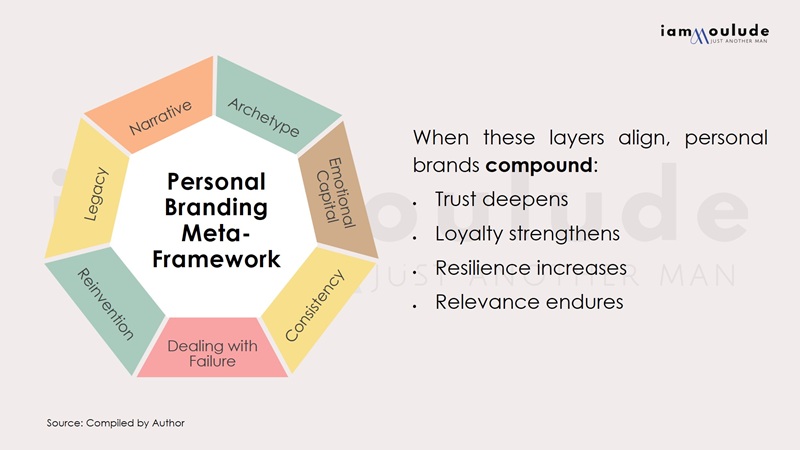
When these layers are aligned:
- Trust deepens: People rely on you with confidence, knowing your actions match your principles.
- Loyalty strengthens: Stakeholders, followers and audiences remain committed over time.
- Resilience increases: Your brand can withstand disruption, failure and criticism without collapsing.
- Relevance endures: Your influence adapts and persists, even as industries, audiences and contexts evolve.
When these layers compound, your personal brand becomes strategic, resilient and legendary – capable of inspiring and influencing far beyond immediate roles or achievements.
To begin, ask yourself the following five critical questions:
- What’s my core narrative?
- What story do I tell about who I am, why I do what I do and the value I bring to others?
- Your narrative anchors your brand and ensures your actions are perceived as intentional rather than reactive.
- What archetype do I represent?
- Are you a Hero, Sage, Rebel, Creator or another archetype?
- Identifying your archetype helps others intuitively understand your brand and anticipate your behavior.
- What emotion do people associate with me?
- Do you evoke trust, inspiration, reassurance or excitement?
- Emotional capital is the currency of influence; the stronger the positive association, the more your brand multiplies.
- Am I consistent without being static?
- Do your actions, decisions and messaging reflect your core identity across contexts?
- At the same time, are you evolving to stay relevant without diluting your essence?
- Am I building a career – or a brand?
- Careers can end, roles change and achievements fade.
- A brand endures by connecting meaningfully with people, surviving disruption and creating a legacy beyond titles or positions.
Concluding Notes
A personal brand is your reputation in action, codified through behavior, consistency and perception. It is the lens through which people experience you and remember you. By thoughtfully aligning your identity, promise, perception and meaning, you create a brand that:
- Builds trust and loyalty with colleagues, clients and audiences
- Strengthens resilience, allowing you to thrive despite setbacks or changes
- Ensures relevance, so your impact lasts across roles, industries and time
Ultimately, personal branding is about intentional influence. It is a commitment to showing up consistently, responding with authenticity, learning from failures and evolving without losing yourself.
Remember: you don’t need fame to be a brand. You only need clarity, purpose and alignment. When applied deliberately, this framework turns everyday choices into a compounding source of trust, impact and legacy — making your personal brand your most enduring asset.
Read More: Personal Branding Playbook: A Shah Rukh Khan Masterclass in Branding, Relevance and Reinvention


 iammoulude
Discussion
Trackbacks/Pingbacks
Pingback: Personal Branding Playbook: A Shah Rukh Khan Masterclass in Branding, Relevance and Reinvention | iammoulude - January 27, 2026