
Bangladesh’s job market does not suffer from a lack of talent as much as it suffers from misallocation of talent. While graduates enter the workforce every year and mid-career professionals look for growth, movement across sectors remains painfully limited.
This is not merely a skills problem.
It is a mindset problem.
In Bangladesh, three dominant formal sectors are in play – FMCG, Telecommunications and Banking. They cannibalize talent mindset-wise, creating invisible walls that prevent capable professionals from moving across sectors, even when the work itself is transferable.
What Is Mindset Cannibalization?
Mindset cannibalization occurs when sector leaders:
- Overvalue sector-specific experience
- Undervalue transferable skills
- Treat “industry background” as a proxy for competence
- Hire defensively to minimize personal and organizational risk
The result is a closed-loop talent system where sectors repeatedly hire from within their own ecosystem – often recycling the same people, while rejecting capable outsiders.
The Three Sectors and Their Talent Worldviews
1. FMCG: Speed, Hustle and Market Intuition
Dominant Leadership Mindset
FMCG leaders often believe:
- “Only FMCG people can survive FMCG pressure”
- Market exposure outweighs structured thinking
- Speed is more important than process
How This Cannibalizes Talent
- Professionals from banking or telecom are viewed as “too slow”, “too theoretical” or “not street-smart”
- Analytical depth is often underutilized
- Leadership equates long hours and rapid execution with competence
Result
FMCG keeps rehiring FMCG people – often from competing brands, rather than importing analytical, digital or risk-oriented talent that could professionalize decision-making.
2. Telecom: Technical Purity and Ecosystem Loyalty
Dominant Leadership Mindset
Telecom leaders often believe:
- “Telecom is too complex for outsiders”
- Network and regulatory knowledge cannot be learned quickly
- Technical background equals leadership readiness
How This Cannibalizes Talent
- FMCG professionals with strong commercial or customer insight are sidelined
- Bankers with risk, compliance or data expertise are seen as irrelevant
- Cross-functional talent is blocked by “ecosystem loyalty bias”
Result
Telecom firms recycle talent internally or across operators, reinforcing sameness and slowing innovation in customer experience, pricing and product thinking.
3. Banking: Risk Aversion as Identity
Dominant Leadership Mindset
Banking leaders often believe:
- “Banking is different – it requires discipline and compliance”
- Non-bank professionals lack governance mindset
- Stability equals competence
How This Cannibalizes Talent
- FMCG leaders are seen as reckless
- Telecom leaders are seen as informal or unstructured
- Innovation roles are filled conservatively or avoided entirely
Result
Banks become insulated talent islands – slow to adapt digitally, hesitant to import external thinking and dependent on legacy career paths.
The Combined Result
Talent does not move freely across sectors in Bangladesh not because it cannot – but because leaders do not trust what they did not grow.
Each sector believes its challenges are unique, its pressure unmatched, and its learning curve too steep – creating a self-reinforcing loop of exclusion.
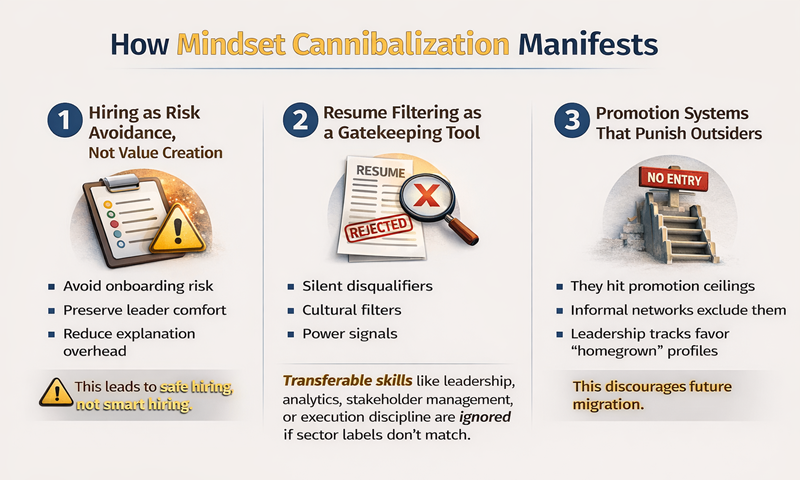
How Mindset Cannibalization Manifests
1. Hiring as Risk Avoidance, Not Value Creation
Hiring decisions are made to:
- Avoid onboarding risk
- Preserve leader comfort
- Reduce explanation overhead
This leads to safe hiring, not smart hiring.
2. Resume Filtering as a Gatekeeping Tool
Sector keywords become:
- Silent disqualifiers
- Cultural filters
- Power signals
Transferable skills like leadership, analytics, stakeholder management or execution discipline are ignored if sector labels don’t match.
3. Promotion Systems That Punish Outsiders
Even when cross-sector hires happen:
- They hit promotion ceilings
- Informal networks exclude them
- Leadership tracks favor “homegrown” profiles
This discourages future migration.
This is not a free market.
This is a segmented talent economy.
Economic and Organizational Cost
Mindset cannibalization leads to:
- Recycled leadership thinking
- Slow innovation
- Talent frustration and brain drain
- Graduate unemployment despite vacancies
- Leadership stagnation
The economy pays the price when skills remain trapped inside sector silos.
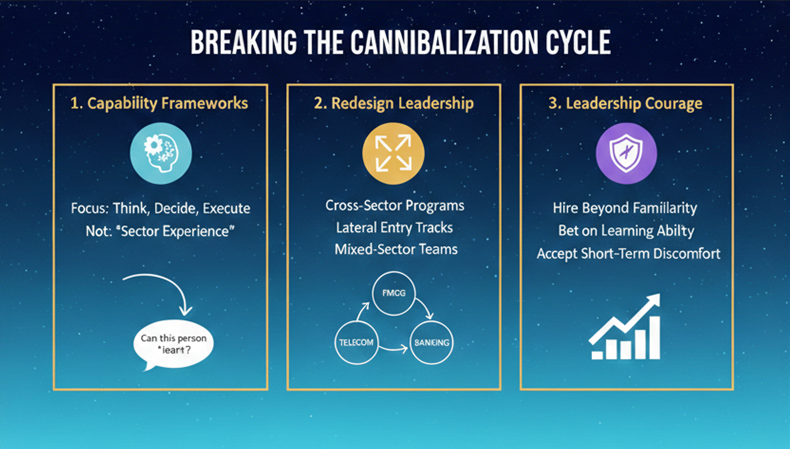
Breaking the Cannibalization Cycle
For professionals looking to move, the secret isn’t just upskilling – it’s Translation. You must learn to translate “FMCG grit” into “Banking resilience” or “Telecom analytics” into “FMCG consumer insights.”
The cannibalization cycle can be break through –
1. Shift from Sector Experience to Capability Frameworks
Leaders must ask:
- Can this person think, decide, and execute?
- Not: “Where did they come from?”
2. Redesign Leadership Pipelines
Introduce:
- Cross-sector leadership programs
- Lateral entry leadership tracks
- Mixed-sector project teams
3. Measure Leadership Courage
The most future-ready leaders will be those who:
- Hire beyond familiarity
- Bet on learning ability
- Accept short-term discomfort for long-term gain
The sector leaders who do hire from other industries are the ones winning the market. They are the “Lateral Thinkers” who realize that a Telecom Data Scientist can revolutionize a Bank’s Credit Scoring, or an FMCG Sales Head can fix a Telecom’s failing distribution network.
Concluding Remarks
Bangladesh does not need more talent. It needs braver leadership mindsets.
Until FMCG, Telecom, and Banking leaders stop cannibalizing talent through fear, familiarity, and ego, the job market will remain fragmented, inefficient, and unfair.
True progress will begin when leaders stop asking:
“Is this person from my sector?”
And start asking:
“Can this person help us grow?”




 iammoulude
Discussion
No comments yet.