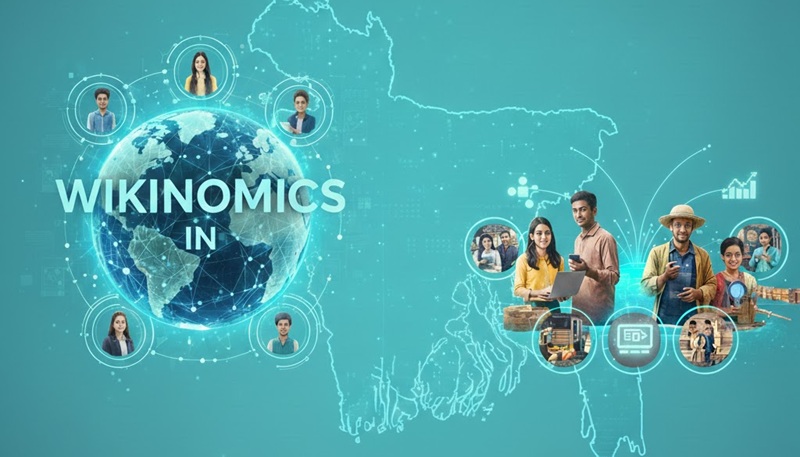
Bangladesh is standing at a critical inflection point. With a young population, rising digital penetration, a fast-growing startup ecosystem and increasing participation in the global digital economy, the country is uniquely positioned to benefit from the new model of value creation – Wikinomics.
In a nation where talent is abundant but often under-leveraged, Wikinomics offers a compelling proposition – growth through mass collaboration rather than centralized control.
Understanding Wikinomics in the Bangladeshi Context
Wikinomics, popularized by Don Tapscott and Anthony D. Williams, emphasizes openness, peering, sharing and global action. While the concept originated in developed digital economies, its relevance is arguably greater in emerging markets like Bangladesh, where constraints demand creativity and collaboration.
In simple terms, Wikinomics answers a key national challenge:
How do we scale innovation when resources are limited but people are not?
Why Bangladesh Is Naturally Suited for Wikinomics
1. Demographic Advantage: A Participation-Ready Population
With more than 60% of its population under the age of 35, Bangladesh possesses one of the largest youth-driven participation bases in the world. From a Wikinomics perspective, this is not merely a labor statistic—it is a collaboration asset.
This generation is:
- Mobile-first in behavior
- Networked through social and digital platforms
- Accustomed to peer learning, content creation and informal collaboration
And Wikinomics thrives in environments where:
- Participation is normalized
- Authority is negotiated, not assumed
- Value creation is peer-driven rather than top-down
Bangladesh’s youth demographic naturally challenges rigid hierarchies and is more receptive to open contribution models, crowdsourcing and co-creation. If this demographic energy is not productively absorbed, it can lead to:
- Underemployment
- Informal value leakage
- Talent migration
Wikinomics offers a scalable way to convert demographic pressure into productive collaboration.
2. Rapid Digital Infrastructure Growth: Enabling Platforms at Scale
Over the past decade, Bangladesh has made significant strides in digital infrastructure:
- Rapid expansion of mobile internet access
- Government-led digital transformation initiatives
- Accelerating adoption of fintech, edtech and e-commerce platforms
This creates the technical substrate required for mass collaboration, which makes Wikinomics a perfect suit.Because without digital rails, openness and collaboration remain aspirational.
Bangladesh’s growing digital ecosystem enables:
- Low-cost coordination across geography
- Real-time participation at scale
- Data-driven feedback loops for innovation
As platforms mature, they shift the economy from transaction-based to interaction-based value creation. Unlike legacy economies burdened by outdated systems, Bangladesh can:
- Leapfrog directly into platform-native collaboration models
- Design openness into systems from inception
- Avoid the inertia of deeply entrenched hierarchies
3. Distributed Talent, Limited Platforms: The Coordination Opportunity
Bangladesh’s talent base is widely distributed rather than concentrated:
- Freelancers serving global markets
- Grassroots innovators addressing local challenges
- University students experimenting with problem-solving and technology
The constraint is not capability – it is coordination.
Traditional organizational models struggle to aggregate informal talent, part-time contributors and/or non-credentialed innovators. While Wikinomics fills this structural gap by:
- Lowering barriers to participation
- Enabling modular contributions
- Allowing value to emerge from the edges rather than the center
This transforms latent talent into visible, scalable output. And When coordination systems are in place:
- Innovation costs decline
- Speed to market increases
- Solutions become more contextually relevant
Bangladesh can unlock collective intelligence without massive capital investment.
The Four Principles of Wikinomics – Bangladesh Edition
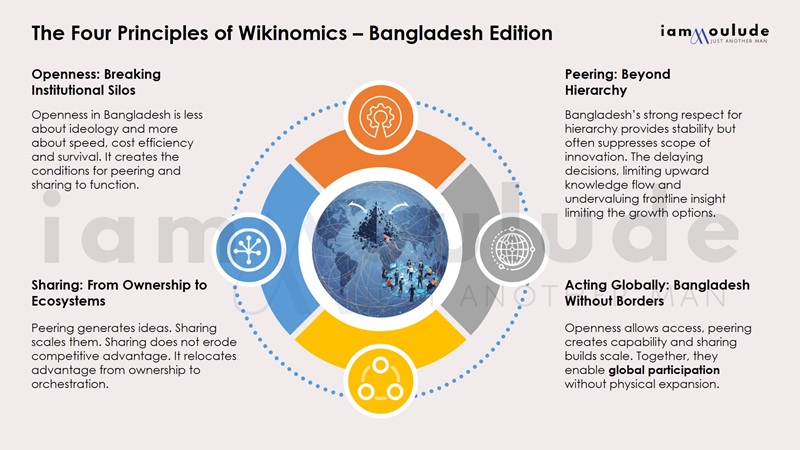
Bangladesh’s transition from efficiency-led growth to innovation-led competitiveness depends on how effectively it mobilizes collective intelligence. The four principles of Wikinomics, when viewed together – form a connected system, not standalone practices.
1. Openness: Breaking Institutional Silos
Many Bangladeshi organizations still operate with closed decision-making, knowledge hoarding and risk-averse leadership. These models slow response time and fragment learning—critical weaknesses in a fast-moving digital economy.
Yet, where openness has been introduced, outcomes have improved:
- Open APIs in fintech enabling interoperability and faster product innovation
- Public–private digital platforms reducing service delivery costs
- Open learning and skill platforms scaling capability development
Connecting the Dots
Openness is the entry point to Wikinomics. Without open access to data, systems and participation, collaboration cannot scale.
Localized Insight
Openness in Bangladesh is less about ideology and more about speed, cost efficiency and survival. It creates the conditions for peering and sharing to function.
2. Peering: Beyond Hierarchy
Bangladesh’s strong respect for hierarchy provides stability but often suppresses scope of innovation. The delaying decisions, limiting upward knowledge flow and undervaluing frontline insight limiting the growth options.
On the other hand, Wikinomics introduces peering, where contribution matters more than title, ideas compete on merit and problem-solving is community-driven. Though in limited scale, this is already visible in:
- Developer and tech communities
- Startup meetups and incubators
- Informal innovation networks
Connecting the Dots
Once systems are open, peering becomes possible. Peering, in turn, activates latent intelligence – especially among youth and early-career professionals. Without peering, openness remains underutilized.
3. Sharing: From Ownership to Ecosystems
Traditional economic models in Bangladesh emphasize ownership and vertical control. While effective in early industrial growth, these models struggle in platform-driven markets. Wikinomics reframes value creation through sharing –
- Shared payment rails lowering entry barriers
- Platform-based logistics enabling SME participation
- Community knowledge sharing improving outcomes in agriculture and education
Connecting the Dots
Peering generates ideas. Sharing scales them. By sharing infrastructure, data and knowledge, Bangladesh can:
- Reduce duplication
- Lower costs
- Accelerate innovation across sectors
Sharing does not erode competitive advantage. It relocates advantage from ownership to orchestration.
4. Acting Globally: Bangladesh Without Borders
Bangladesh is already part of global collaboration networks in forms like freelancers on international platforms, growing IT and software exports and diaspora-driven knowledge flows.
However, much of this participation remains transactional – focused on labor, not intellectual property. Wikinomics enables Bangladesh to:
- Export ideas, not just effort
- Co-create global products
- Participate in international innovation ecosystems
Connecting the Dots
Openness allows access, peering creates capability and sharing builds scale. Together, they enable global participation without physical expansion.
Wikinomics in Action: Bangladesh Inspired Examples
Bangladesh’s most successful digital sectors already reflect Wikinomic behavior, even when not explicitly labeled as such. These cases demonstrate how mass collaboration, platforms and peer coordination translate into real economic outcomes.
1. Freelance Economy: Mass Collaboration at Scale
Bangladesh consistently ranks among the top global freelancing nations by volume of active workers. This ecosystem operates through:
- Highly distributed talent pools across cities and rural areas
- Platform-based coordination (marketplaces, rating systems, algorithmic matching)
- Peer learning and informal mentoring communities (online forums, social groups, bootcamps)
From a Wikinomics lens, this system exhibits low entry barriers, merit-based visibility and rapid skill diffusion without centralized training institutions. This is Wikinomics without institutions. If formal systems – universities, banks, export agencies were integrated:
- Talent aggregation could improve
- IP creation could increase
- Value capture could shift from labor arbitrage to solution ownership
Informal collaboration already works but formal coordination could compound it.
2. Fintech & Digital Payments: Collaboration as Infrastructure
Financial inclusion accelerates when infrastructure is shared, not duplicated. Additionally, the classic platform economics theory also implies – marginal transaction costs decline as participation increases. Bangladesh’s digital financial ecosystem demonstrates a clear Wikinomics pattern, where –
- Banks, MFS providers, regulators, merchants and developers operate on shared rails
- Interoperability expands the total market rather than redistributing a fixed one
- Public–private coordination reduces friction and adoption costs
Key structural indicators in this space includes rapid growth in digital transaction, increasing merchant acceptance and regulatory frameworks that prioritize system stability over firm dominance. No single institution – bank or fintech can scale inclusion alone. Value is created at the ecosystem level, not the firm level.
This is Wikinomics applied to national infrastructure, not just startups.
3. EdTech & Learning Communities: From Consumption to Contribution
Bangladesh’s EdTech sector is evolving from content delivery to participatory learning systems. Fundamentally learning platforms scale faster when learners become contributors and knowledge retention improves when teaching is peer-mediated rather than purely top-down. The structural signals include but not limited to –
- Growth in instructor-led community platforms
- Increased reliance on user-generated explanations, notes and problem-solving
- Informal certification through community reputation rather than institutional branding
Education in Bangladesh cannot scale linearly through institutions alone. Wikinomics turns education into a knowledge commons, where:
- Institutions curate
- Communities contribute
- Platforms coordinate
This lowers cost, increases relevance and accelerates skill diffusion.
Wikinomics vs Traditional (Bangladesh Context)
Let’s have a deeper look onto Wikinomics against traditional orbitational culture in Bangladesh context.
| Dimension | Traditional Practice | Wikinomics Shift | Wikinomics Strategic Pros | Wikinomics Strategic Cons |
| Basis of Authority | Seniority-driven; tenure equals influence | Contribution-driven; value creation earns voice | Faster decision-making High-performers surface quickly Reduces political inertia | Resistance from senior leadership Cultural discomfort with flat power structures |
| Control & Governance | Control-focused; approvals and gatekeeping | Trust-based; autonomy with accountability | Increased speed and adaptability Encourages ownership mindset | Risk of inconsistency Requires strong norms and safeguards |
| Talent Model | Internal talent prioritized | Open talent ecosystems (freelancers, partners, communities) | Access to global skills Lower fixed costs Rapid capability scaling | IP protection challenges Coordination complexity |
| Risk Orientation | Risk avoidance; fear of failure | Experimentation and iteration | Faster innovation cyclesLearning through pilots Better product-market fit | Short-term inefficiencies Failure stigma still culturally strong |
| Organizational Structure | Departmental silos | Ecosystem thinking across boundaries | Cross-functional innovation Reduced duplication of effort | Blurred accountability Requires ecosystem orchestration skills |
| Decision Making | Top-down; centralized | Distributed; insight-driven | Better use of frontline intelligence Higher engagement levels | Risk of decision fragmentation Needs clear escalation rules |
| Knowledge Flow | Knowledge hoarding as power | Open knowledge sharing | Faster capability diffusion Collective problem solving | Free-rider risks Cultural shift needed from “ownership” to “stewardship” |
Wikinomics does not imply abandoning discipline, hierarchy or leadership.
It implies re-architecting authority, talent and trust to match a digital, networked economy. In Bangladesh, the biggest barrier to Wikinomics is not technology – it is organizational psychology and legacy power structures.
Challenges Unique to Bangladesh
Wikinomics adoption is not without friction. While Bangladesh possesses strong demographic and digital tailwinds for Wikinomics, the transition from hierarchy-centric institutions to network-driven collaboration faces distinct structural and behavioral constraints.
- Low trust in open systems
- Fear of idea theft
- Weak governance models
- Leadership discomfort with loss of control
In a nutshell, the biggest barrier is not technology – it is mindset.
Closing Notes
For Bangladesh, Wikinomics is not a luxury – it is a necessity. In a resource-constrained but talent-rich nation, collaboration is the most scalable economic strategy. The future of Bangladesh will not be built by a few institutions – but by millions of connected contributors. To capitalize the opportunities, Bangladeshi leaders must evolve from –
- Decision-makers → Platform enablers
- Controllers → Ecosystem orchestrators
- Owners → Trust builders
Leadership success will be measured not by how much one controls—but by how many others can create value through you.
More on Wikinomics: From Hierarchies to Networks: How Wikinomics Redefined Competitive Advantage Through Collaboration







Discussion
Trackbacks/Pingbacks
Pingback: From Hierarchies to Networks: How Wikinomics Redefined Competitive Advantage Through Collaboration | iammoulude - February 23, 2026