
For a long time, I believed toxic workplaces were easy to identify. Loud arguments. Open hostility. Public humiliation.
But… I was wrong.
Most toxic workplaces don’t announce themselves. They operate quietly, almost politely. From the outside, everything looks “normal.” Deadlines are being met. Meetings are happening. People are busy.
But underneath, something slowly breaks.
Toxic leadership isn’t poor management or a lack of skills. It’s not that simple actually. It’s a recurring pattern of behavior where leaders chase results in ways that gradually damage people, culture and the organization itself – often at the direct expense of the teams they are meant to serve.
What Toxic Leadership Really Means
At its core, toxic leadership is driven by self-interest. Power, control, recognition and status take priority over trust, fairness and collective success. While these leaders may deliver short-term wins, they do so by eroding morale, weakening relationships and compromising long-term performance.
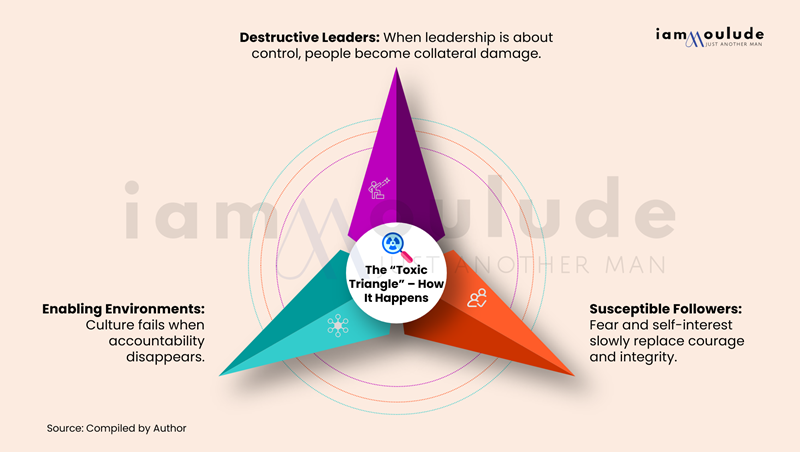
The “Toxic Triangle” — How It Happens
Toxic leadership rarely emerges on its own. It takes shape when three forces converge – leadership behavior, follower response and organizational conditions. These three forces form the “Toxic Triangle”.
- Destructive Leaders: Individuals driven by ego, control and personal gain. Their confidence and charisma often hide deep insecurities, ethical gaps and a hunger for power that prioritizes self-interest over people.
- Susceptible Followers: Team members who comply, stay silent or even enable harmful behavior – sometimes out of fear, sometimes for protection or personal advantage. This allows toxicity to take root and spread.
- Enabling Environments — Organizational conditions marked by uncertainty, weak accountability, unclear values or a culture of fear, where poor behavior goes unchecked and authority is rarely questioned.
Together, this triangle creates a system where toxic behavior is normalized, sustained and in some cases quietly rewarded – until it becomes the culture itself.
What Toxic Leadership Actually Feels Like
I’ve learned that toxic leadership isn’t always about shouting or aggression. Sometimes it’s much more subtle. It shows up as:
- Constant urgency where nothing is truly urgent
- Instructions without context, but pressure without end
- Micromanagement disguised as “support”
- Policies that feel fair on paper but unfair in practice
- Priorities that change so often you stop caring
Over time, you don’t feel angry – you feel tired. And that tiredness becomes emotional.
The Leaders I Respected Most
The best leaders I’ve worked with did something very simple but very powerful – they protected their teams.
They acted like an umbrella — standing between us and unnecessary chaos. They filtered pressure instead of passing it down. They gave clarity instead of confusion.
Their guidance came with wisdom and then they let us work in our own style. No micromanagement. No constant checking. Just trust. That kind of leadership doesn’t just deliver results — it builds confidence, loyalty and growth.
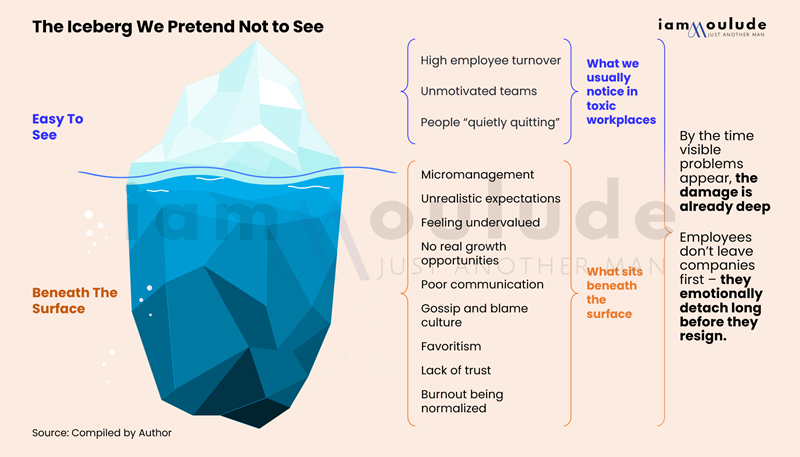
The Iceberg We Pretend Not to See
What we usually notice in toxic workplaces are the obvious things:
- High employee turnover
- Unmotivated teams
- People “quietly quitting”
But those are just symptoms.
What sits beneath the surface is far more damaging:
- Micromanagement
- Unrealistic expectations
- Feeling undervalued
- No real growth opportunities
- Poor communication
- Gossip and blame culture
- Favoritism
- Lack of trust
- Burnout being normalized
By the time people resign, they’ve already left emotionally. The resignation letter is just paperwork.
Quiet Quitting Isn’t Laziness
I don’t believe quiet quitting is about people being lazy or unambitious. I think it happens when people realize that caring costs them more than it gives back.
When effort isn’t recognized.
When growth is promised but never delivered.
When honesty is punished and silence is rewarded.
So people protect themselves the only way they can – by doing less, feeling less, expecting less.
How Toxic Cultures Are Actually Built
Toxic workplaces are rarely created overnight. They are built slowly, through patterns that leaders tolerate:
- Rewarding overwork instead of impact
- Confusing control with accountability
- Valuing loyalty over competence
- Asking for transparency without offering psychological safety
- Expecting flexibility without giving any
These patterns teach people one thing very clearly:
“Keep your head down. Don’t question. Just survive.”
And that’s when culture stops being human.
The Real Cost We Don’t Measure or No Balance Sheet Shows
Toxic leadership doesn’t just harm people – it quietly destroys organizations.
Creativity disappears.
High performers leave first.
Decision-making becomes slow and political.
Mediocrity feels safe.
And often, leaders blame the team for problems created by the system they designed.
Lessons I’ve Learned Along the Way
People don’t perform best when they’re watched—they perform best when they’re trusted.
- Pressure flows downhill — unless leaders stop it
Teams don’t fail because of pressure; they fail when leaders pass pressure down without context, clarity or care. - Micromanagement kills ownership faster than mistakes ever could
People grow when they’re trusted. Constant control only creates fear and dependency. - Quiet quitting starts long before people stop trying
By the time effort drops, emotional disengagement has already happened — usually ignored for too long. - Culture is built in small, repeated behaviors
How feedback is given, how mistakes are handled and who gets favored silently shape culture more than any policy document. - Results improve when people feel safe, not watched
Psychological safety isn’t a “soft” concept — it’s a performance multiplier. - Good leaders are remembered for how they made people feel
Titles fade. KPIs change. But the feeling of being respected, trusted, and protected stays.
What I Now Believe About Leadership
Leadership isn’t about control.
It’s not about being the smartest person in the room.
And it’s definitely not about fear.
Real leadership is about creating safety – so people can think, speak and do their best work.
It’s about setting clear direction and then trusting people to walk the path.
It’s about protecting your team, not using them as shock absorbers.
Final Reflection
Toxic workplaces are not an accident. They are the result of leadership choices — repeated every day.
If you’re in a leadership role, ask yourself honestly:
- Do my people feel safe around me?
- Am I shielding them from chaos or adding to it?
- Do they grow under my leadership — or just endure it?
Because in the end, culture isn’t what we write on office walls.
It’s what people feel on Thursday night, thinking about Sunday morning.
And that feeling tells the truth every time.




 iammoulude
Discussion
No comments yet.