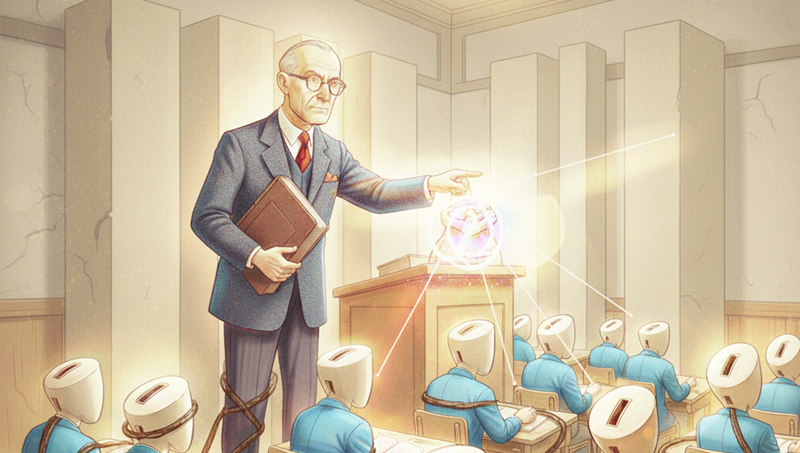
In the realm of educational theory, few ideas have sparked as much debate and transformation as Paulo Freire’s critique of what he calls the “banking concept of education.” First introduced in his seminal work Pedagogy of the Oppressed (originally published in Portuguese in 1968 and in English in 1970), this concept challenges the very foundations of how we think about teaching and learning.
Freire, a Brazilian educator and philosopher, argued that traditional education often treats students as passive recipients of knowledge, stifling their creativity and critical thinking. In this blog post, will dive deep into what banking education entails, its key characteristics, Freire’s criticisms, the alternative he proposed and why it still matters in today’s world. Whether you’re a teacher, student or lifelong learner, understanding this concept can reshape how you view education.
Who Was Paulo Freire?
Before we unpack the banking model, let’s get to know the man behind it. Paulo Freire (1921–1997) was a pioneering figure in critical pedagogy, born in Recife, Brazil, during a time of economic hardship.
His early experiences with poverty and hunger profoundly influenced his views on education as a tool for social justice. Freire worked extensively in adult literacy programs, helping illiterate peasants in Brazil learn to read and write in just 45 days through culturally relevant methods. Exiled during Brazil’s military dictatorship in 1964, he continued his work globally, influencing educators in Latin America, Africa and beyond.
Freire’s philosophy was rooted in liberation theology and Marxism, emphasizing education’s role in humanizing the oppressed and fostering critical consciousness (or “conscientização” in Portuguese).
He believed education should empower people to challenge oppressive structures, not reinforce them. His ideas gained international acclaim, but they also drew criticism for being too radical or idealistic. Nonetheless, Freire’s work remains a cornerstone of progressive education theories.
What Is the Banking Concept of Education?
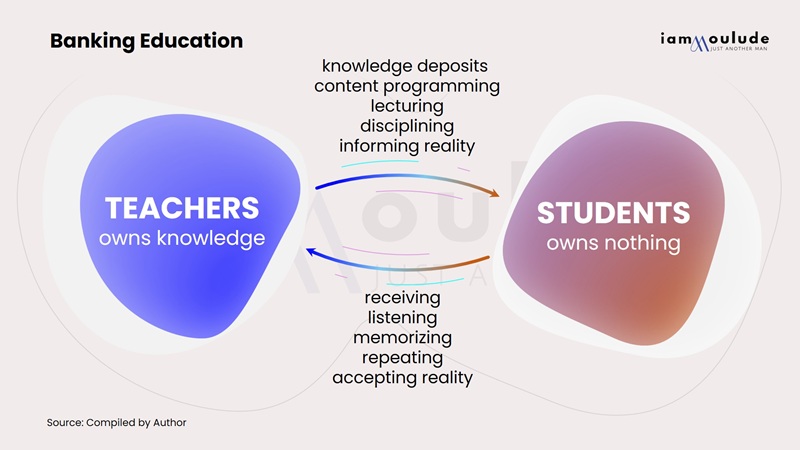
At its core, the banking concept of education is a metaphor Freire used to describe a flawed system where teachers “deposit” information into students, who act as empty “containers” or “receptacles” to be filled.
In Freire’s words:
“Education thus becomes an act of depositing, in which the students are the depositories and the teacher is the depositor.”
Instead of fostering dialogue or inquiry, this model turns education into a one-way street: teachers narrate facts and students memorize and regurgitate them without question. Freire likened this to a banking transaction because knowledge is treated as a static commodity – gifted from the “knowledgeable” teacher to the “ignorant” student.
Reality is presented as “motionless, static, compartmentalized and predictable,” disconnected from students’ lived experiences.
Words and concepts become “hollow, alienated and alienating verbosity,” losing their power to transform the world. This approach assumes a dichotomy between humans and the world: students’ minds are empty vessels passively receiving content, while teachers regulate what enters and how it’s stored.
The scope of student action is limited to “receiving, filing and storing the deposits,” much like a bank account.
Key Characteristics of Banking Education
Freire outlined several defining traits of this model, highlighting the oppressive teacher-student dynamic. Here they are, drawn directly from his analysis:
- The teacher teaches and the students are taught.
- The teacher knows everything and the students know nothing.
- The teacher thinks and the students are thought about.
- The teacher talks and the students listen—meekly.
- The teacher disciplines and the students are disciplined.
- The teacher chooses and enforces his choice and the students comply.
- The teacher acts and the students have the illusion of acting through the action of the teacher.
- The teacher chooses the program content and the students (who were not consulted) adapt to it.
- The teacher confuses the authority of knowledge with his or her own professional authority, which she and he sets in opposition to the freedom of the students.
- The teacher is the Subject of the learning process, while the pupils are mere objects.
These characteristics paint a picture of a hierarchical, authoritarian system where students are adaptable and manageable, but not creative or critical.
Education becomes a tool for domestication, aligning with broader societal oppression by minimizing students’ creative power and stimulating their credulity.
Freire’s Criticisms: Why Banking Education Fails
Freire didn’t just describe banking education – he eviscerated it as a form of oppression that hinders humanization.
One major critique is that it negates education as a process of inquiry: “The banking method emphasizes permanence and becomes reactionary; problem-posing education—which accepts neither a ‘well-behaved’ present nor a predetermined future—roots itself in the dynamic present and becomes revolutionary.”
By treating students as passive objects, it alienates them from their own learning, much like slaves in a Hegelian dialectic who don’t recognize their role in educating the master. It mythicizes reality, concealing facts about human existence and resisting dialogue, which Freire saw as essential for liberation.
This model serves the interests of oppressors, using “humanitarianism” to mask exploitation and integrate the oppressed into the system rather than transforming it. Furthermore, banking education fosters “necrophily”—a love of death, control and mechanical processes – over “biophily,” which embraces life and growth.
It inhibits critical consciousness, leading to fatalism and adaptation to injustice. In urban schools, for instance, it manifests in standardized testing that prioritizes rote memorization over meaningful learning, perpetuating cycles of failure.
Freire argued that this approach objectifies students, preventing them from becoming fully human and reinforcing power imbalances.
The Alternative: Problem-Posing Education
In opposition to banking, Freire proposed “problem-posing education,” where teachers and students become co-investigators in dialogue.
Here, education is a practice of freedom: problems are posed based on students’ realities, encouraging critical reflection and action (praxis). “Problem-posing education affirms men and women as beings in the process of becoming – as unfinished, uncompleted beings in and with a likewise unfinished reality.”
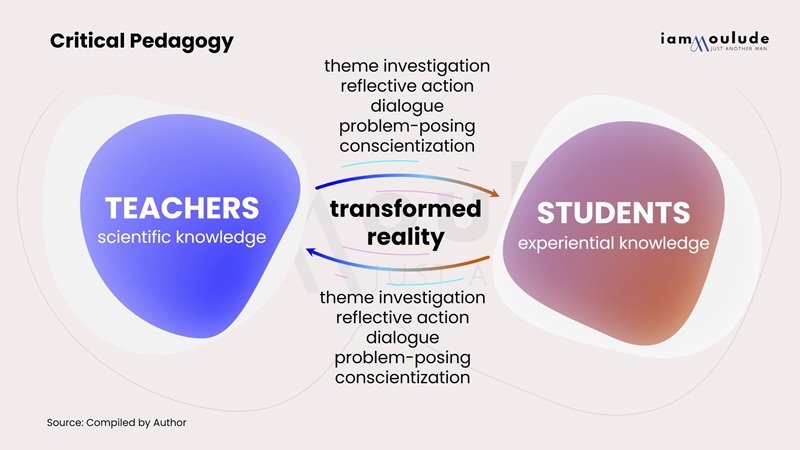
This model resolves the teacher-student contradiction by making both “teacher-students” and “student-teachers,” fostering mutual humanization.
It promotes creativity, inquiry and transformation, aligning with Freire’s belief that humans are historical beings capable of changing the world. Educators who’ve adopted this, like those in Reddit discussions, report deeper learning and empowerment.
Relevance in Today’s World
Decades after Freire’s writing, the banking model persists in many classrooms, exacerbated by high-stakes testing, overcrowded curricula and digital rote-learning apps.
In an era of misinformation and social inequality, Freire’s call for critical pedagogy is more urgent than ever. Movements like critical race theory in education echo his ideas, pushing for curricula that address systemic oppression.
However, implementing problem-posing isn’t easy – it requires rethinking power dynamics and embracing uncertainty. Yet, in sustainability education or community-based learning, we see Freire’s influence thriving, encouraging learners to critique and act on real-world issues.
As one educator put it, Freire’s radical approach inspires “critical thinking and having the students teach each other.”
Concluding Remarks
Paulo Freire’s banking concept of education isn’t just a critique—it’s a rallying cry for change. By exposing how traditional methods domesticate rather than liberate, Freire invites us to reimagine education as a dialogical, humanizing force.
In a world grappling with inequality, embracing problem-posing could empower the next generation to build a more just society. If you’re in education, reflect: Are you depositing knowledge or co-creating it? Freire’s legacy reminds us that true learning transforms both the learner and the world.
What are your thoughts on Freire’s ideas? Have you experienced banking education in your life? Share in the comments below!
More on Paulo Freire: Consciousness, Humankind and the Quest for Liberatory Education




 iammoulude
Discussion
Trackbacks/Pingbacks
Pingback: Revisiting Freire: Consciousness, Humankind and the Quest for Liberatory Education | iammoulude - February 4, 2026