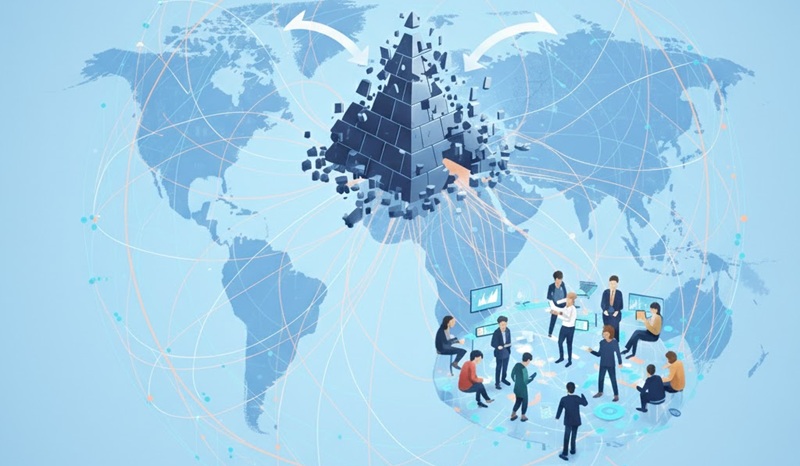
In an era where knowledge is distributed, innovation is democratized and value creation transcends organizational boundaries, traditional top-down business models are losing relevance. Enter Wikinomics – a powerful framework that redefines how individuals, organizations and societies collaborate to create value at scale.
Coined by Don Tapscott and Anthony D. Williams, Wikinomics captures the profound shift from closed, hierarchical systems to open, participatory and collaborative ecosystems. It is not merely a management trend; it is a new economic logic for the digital age.
What Is Wikinomics?
Wikinomics refers to the mass collaboration model where people often strangers co-create products, solutions and knowledge using digital platforms. Inspired by the success of Wikipedia, it demonstrates that large, loosely connected communities can outperform traditional institutions when properly orchestrated.
At its core, Wikinomics challenges one fundamental assumption of old-school economics:
“The smartest people work for us.”
In the Wikinomics world, the smarter assumption is:
“The smartest people work everywhere.”
The Core Principles of Wikinomics
Wikinomics is not a single practice – it is a system of principles that together enable organizations, communities and societies to create value at scale. These principles redefine how work is organized, how innovation happens and how trust is built in the digital economy.
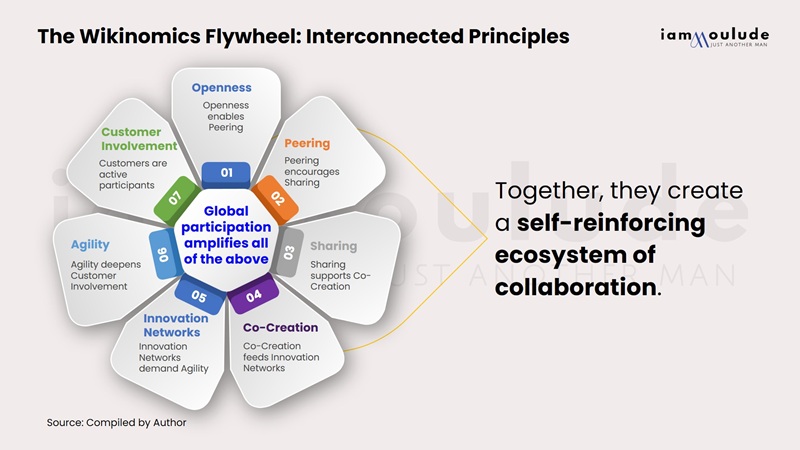
Let’s break down each principle in depth.
1. Openness
Openness refers to opening organizational boundaries to ideas, talent, data and collaboration beyond internal teams. While in traditional models, knowledge is protected. In Wikinomics, knowledge flows.
| How It Works Open-source platforms Open innovation challenges Transparent decision-making Shared APIs and data access | Why It Matters Accelerates innovation cycles Reduces duplication of effort Attracts external intelligence Builds trust and credibility |
| Real-World Example: Open-source software (Linux) Anyone can review, modify and improve code Quality improves through peer scrutiny Companies benefit from a shared innovation base | |
Strategic Insight
Openness is not about giving everything away – it’s about sharing selectively to gain ecosystem advantage.
2. Peering (Peer-Based Production)
Peering replaces hierarchical command structures with peer-based collaboration, where authority comes from contribution – not position.
| How It Works Self-organizing teams Flat collaboration structures Merit-based influence Distributed leadership | Why It Matters Unlocks intrinsic motivation Encourages ownership and accountability Enables faster problem-solving Reduces bureaucracy |
| Real-World Example: Wikipedia No central editor-in-chief Articles are created, reviewed and improved by peers Trust is built through collective governance | |
Strategic Insight
In peer systems, credibility replaces control.
3. Sharing
Sharing is the strategic exchange of resources – knowledge, code, designs and data to create mutual value.
| How It Works Shared intellectual assets Knowledge repositories Collaborative platforms Industry consortia | Why It Matters Reduces cost and risk Builds collective intelligence Strengthens ecosystem relationships Enables faster scaling |
| Real-World Example: Linux Foundation Companies share foundational technologies Compete on differentiation layers Collaborate on core infrastructure | |
Strategic Insight
Sharing creates network effects – the more participants contribute, the more valuable the system becomes.
4. Acting Globally
Wikinomics thrives on global participation, leveraging diverse skills, cultures and perspectives without geographic boundaries.
| How It Works Distributed teams Remote collaboration platforms Open global communities 24/7 innovation cycles | Why It Matters Expands talent access Enhances creativity through diversity Enables continuous development Reduces dependency on local resources |
| Real-World Example: GitHub Developers across continents collaborate in real time Projects evolve continuously across time zones | |
Strategic Insight
Global collaboration turns time zones into a competitive advantage.
5. Co-Creation
Co-creation involves stakeholders – customers, partners, communities in joint value creation, not just feedback or consumption.
| How It Works Crowdsourced ideas Community voting User-generated designs Collaborative problem-solving | Why It Matters Increases market relevance Reduces product-market mismatch Builds emotional ownership Turns users into advocates |
| Real-World Example: LEGO Ideas Fans submit product concepts Community selects winning designs Creators share revenue | |
Strategic Insight
Co-creation shifts organizations from value delivery to value discovery.
6. Innovation Networks
Innovation networks replace isolated R&D with ecosystems of contributors – startups, universities, freelancers and communities.
| How It Works Partner ecosystems Startup accelerators Open research collaborations Platform-based innovation | Why It Matters Increase idea diversity Reduce innovation risk Enable faster experimentation Unlock cross-industry breakthroughs |
| Real-World Example: Procter & Gamble’s “Connect + Develop” External innovation accounts for over half of new products Global network outperforms internal labs | |
Strategic Insight
Innovation is no longer a department – it is a network capability.
7. Agile Operation
Agile operation is the ability to adapt, iterate and respond quickly using collaborative workflows and continuous feedback.
| How It Works Rapid experimentation Short development cycles Cross-functional teams Continuous improvement | Why It Matters Reduces time-to-market Increases resilience Enables faster learning Aligns with dynamic environments |
| Real-World Example: Open-source development cycles Frequent releases Continuous testing Community-driven improvements | |
Strategic Insight
Agility transforms uncertainty from a risk into an innovation engine.
8. Customer Involvement
Customers are not passive end-users – they are active participants in design, testing and improvement.
| How It Works Beta communities Feedback loops User analytics Community forums | Why It Matters Improves adoption Reduces failure rates Strengthens loyalty Builds trust through transparency |
| Real-World Example: Open beta software programs Users test and shape features before launch Products evolve based on real needs | |
Strategic Insight
The most powerful customer insight comes after customers start building with you.
Why Wikinomics Matters More Than Ever: A Deep Dive
In today’s world, traditional business models are increasingly outpaced by complexity, decentralization and speed. The rules of value creation are no longer confined to corporate walls, fixed hierarchies or controlled R&D labs. The Wikinomics model, grounded in mass collaboration, openness and global participation, is not just a trend – it’s a strategic imperative.
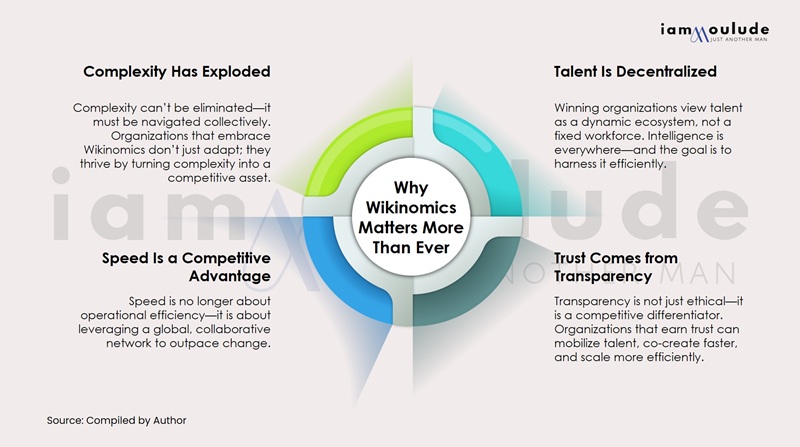
Here’s a detailed look at why Wikinomics matters more than ever:
1. Complexity Has Exploded: The Age of Interconnected Challenges
The problems organizations face today are multi-dimensional, cross-sectoral and rapidly evolving. No single company, government or institution possesses all the knowledge, tools or expertise to solve them alone. Technology, climate change, healthcare crises and financial disruptions intersect in ways that make traditional linear problem-solving ineffective.
Real-World Illustration
- Healthcare: Tackling a global pandemic requires collaboration among pharmaceutical companies, hospitals, government agencies, tech providers and data scientists – simultaneously. A siloed approach would delay innovation and exacerbate harm.
- Climate: Renewable energy solutions involve engineering, policy, finance, behavior change and international diplomacy. Multilateral collaboration is mandatory.
Why Traditional Approaches Fail
Closed organizations tend to:
- Operate in silos, missing cross-disciplinary insights
- Prioritize internal efficiency over ecosystem learning
- Respond reactively, not proactively
Wikinomics Advantage
- Distributed problem-solving: By connecting diverse minds, solutions emerge faster and more creatively
- Knowledge amplification: Open collaboration allows each participant’s insight to build on others’, exponentially increasing collective intelligence
- Adaptive experimentation: Continuous testing and iteration becomes feasible on a global scale
Key Takeaways: Complexity can’t be eliminated – it must be navigated collectively. Organizations that embrace Wikinomics don’t just adapt; they thrive by turning complexity into a competitive asset.
2. Talent Is Decentralized: The New Geography of Intelligence
In the past, talent was concentrated in elite companies or prestigious institutions. Today, the smartest minds are distributed globally: freelance innovators, open-source contributors, independent researchers and community specialists. They often operate outside formal hierarchies, choosing projects aligned with passion and purpose.
Real-World Illustration
- Open-source software: Linux, Python and TensorFlow thrive because thousands of developers across continents contribute voluntarily.
- Freelance design and analytics: Remote platforms like Kaggle and Upwork allow organizations to tap into specialized expertise without hiring full-time employees.
Why Traditional Talent Models Fail
Relying only on full-time employees:
- Restricts access to specialized skills
- Delays scaling innovation
- Limits diversity of thought
Wikinomics Advantage
- Global access: Talent is sourced based on expertise, not location
- Diversity of thought: Different backgrounds and perspectives create more robust solutions
- Rapid mobilization: Communities self-organize to address pressing challenges
Key Takeaways: Winning organizations view talent as a dynamic ecosystem, not a fixed workforce. Intelligence is everywhere – and the goal is to harness it efficiently.
3. Speed Is a Competitive Advantage: Collaboration Beats Hierarchy
Markets, technologies and consumer preferences now evolve at unprecedented speed. A product cycle that once took years now may take months – or weeks. Organizations that cannot iterate quickly lose relevance.
Real-World Illustration
- GitHub projects: Software development cycles happen in real-time, with contributors from multiple continents submitting, testing and refining code simultaneously.
- Crowdsourced design platforms: LEGO Ideas or Threadless allow users to co-create, validate and launch products faster than traditional R&D could.
Why Traditional Innovation Is Too Slow
Hierarchical, siloed innovation:
- Has long approval cycles
- Concentrates decision-making
- Slows response to market shifts
Wikinomics Advantage
- Parallel experimentation accelerates discovery
- Continuous feedback loops reduce errors
- Networks of contributors accelerate learning and improvement
Key Takeaways: Speed is no longer about operational efficiency – it is about leveraging a global, collaborative network to outpace change.
4. Trust Comes from Transparency: Openness as a Strategic Asset
In the digital age, stakeholders – customers, regulators, partners, employees are hyper-aware, skeptical and vocal. Hidden agendas or opaque processes are quickly exposed and penalized. Trust must be designed into systems, not assumed.
Real-World Illustration
- Open-source software: Communities trust Linux or TensorFlow because all contributions, discussions and changes are visible and auditable.
- Consumer co-creation: Companies like Threadless or LEGO build trust by allowing customers to participate in design decisions and sharing revenue transparently.
Why Traditional Models Fail
- Breed suspicion and disengagement
- Create brand risk in the age of instant digital transparency
- Limit collaboration because external contributors lack confidence
Wikinomics Advantage
- Transparent processes build credibility
- Open feedback loops create accountability
- Sharing insights publicly strengthens community engagement
Key Takeaways: Transparency is not just ethical – it is a competitive differentiator. Organizations that earn trust can mobilize talent, co-create faster and scale more efficiently.
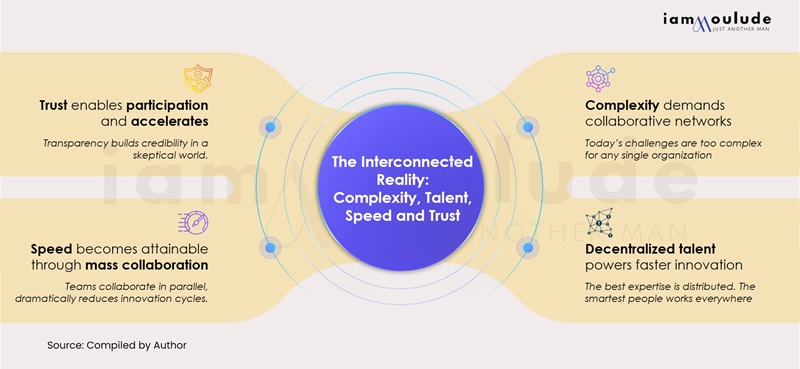
The Interconnected Reality: Complexity, Talent, Speed and Trust
All four forces reinforce each other:
- Complexity demands collaborative networks
- Decentralized talent powers faster innovation
- Speed becomes attainable through mass collaboration
- Trust enables participation and accelerates adoption
Wikinomics is the organizational response to these forces. It’s not an optional strategy; it is a structural necessity for survival and growth in the modern economy.
Wikinomics vs Traditional Economics
| Category | Traditional Model | Wikinomics Model | Pros | Cons |
| Innovation Approach | Closed Innovation | Open Innovation | Faster innovation, diverse ideas, external expertise | Risk of IP leakage, coordination complexity |
| Organizational Structure | Hierarchies | Peer Networks | Flexible, encourages contribution, faster problem-solving | Hard to manage, potential lack of accountability |
| Management Focus | Control-focused | Trust-focused | Builds engagement, attracts talent, encourages collaboration | Requires cultural shift, trust must be earned |
| Market Orientation | Firm-centric | Ecosystem-centric | Leverages partnerships, accelerates value creation | Complexity in managing partnerships, dependency on ecosystem |
| Knowledge & Resources | Knowledge hoarding | Knowledge sharing | Network effect, collective intelligence, faster learning | Needs governance to maintain quality and relevance |
In the age of Wikinomics, value is no longer created in isolation—it is co-created across networks, cultures and disciplines. To compete organizations must design for collaboration, not control.
The Future of Wikinomics
As AI, blockchain and digital platforms mature, Wikinomics will evolve further:
- AI-enhanced collaboration (human + machine co-creation)
- Decentralized autonomous organizations (DAOs)
- Tokenized incentive systems
- Global digital commons
The organizations that win will not be the most secretive – but the most collaborative, adaptive and open.
Closing Thought
Wikinomics is not about abandoning structure – it is about redesigning it for a connected world. The organizations that thrive will not be those with the tightest control – but those with the strongest collaborative architecture.
Wikinomics is both an art and a science.
- The science lies in systems, platforms, governance and incentives.
- The art lies in trust, culture, purpose and shared belief.
In a world where value is increasingly created together, the future belongs to those who understand one simple truth:
Collaboration is no longer a support function – it is the strategy.
More on Wikinomics: Bangladesh’s Wikinomics Moment: Transforming Business and Innovation Through Mass Collaboration




 iammoulude
Discussion
Trackbacks/Pingbacks
Pingback: Bangladesh’s Wikinomics Moment: Transforming Business and Innovation Through Mass Collaboration | iammoulude - February 23, 2026