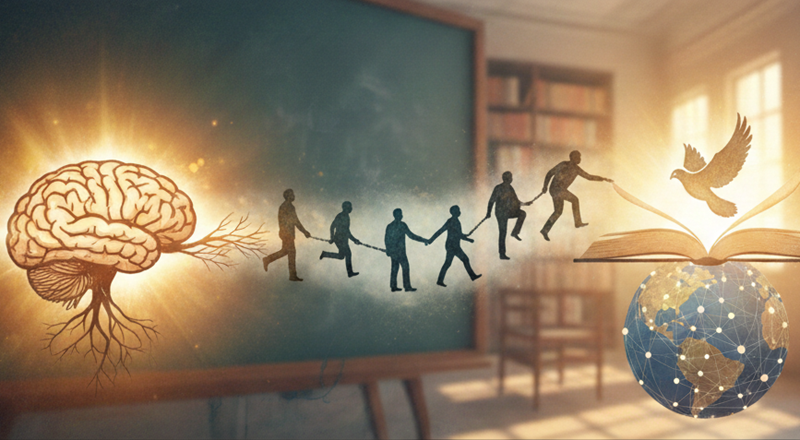
“There is no neutral process of education. Education works as an instrument fostering the generations’ integration in the actual ruling system’s logic assimilating conformism, or transforms itself in the practice of freedom, the way to men and women critically deal with reality and discover how to participate in the transformation of their world.”
– Paulo Freire (1921-1997)
This profound statement from Paulo Freire encapsulates the binary nature of education; it either perpetuates oppression or ignites liberation. As a former educator with over three years in the classroom, I grappled with this dichotomy firsthand. The conventional educational system often felt like a one-way street, where knowledge was imposed on students like deposits in a bank – devoid of dialogue, creativity or relevance to their lived realities.
My attempts to foster two-way communication between teachers and students led me to Freire’s “Banking Education” theory, which critiqued this model as dehumanizing. In Pedagogy of the Oppressed, Freire describes it like –
“Education thus becomes an act of depositing, in which the students are the depositories and the teacher is the depositor. Instead of communicating, the teacher issues communiques and makes deposits which the students patiently receive, memorize, and repeat. This is the ‘banking’ concept of education, in which the scope of action allowed to the students extends only as far as receiving, filing, and storing the deposits. They do, it is true, have the opportunity to become collectors or cataloguers of the things they store. But in the last analysis, it is the people themselves who are filed away through the lack of creativity, transformation, and knowledge in this (at best) misguided system. For apart from inquiry, apart from the praxis, individuals cannot be truly human. Knowledge emerges only through invention and re-invention, through the restless, impatient continuing, hopeful inquiry human beings pursue in the world, with the world, and with each other.”
While this summary captures the essence, a deeper analytical review reveals the chasm between theory and practice. Freire’s critique isn’t just descriptive; it’s prescriptive, urging educators to dismantle hierarchical structures. However, implementing this in real-world settings – plagued by standardized testing, resource constraints, and institutional inertia; poses significant challenges.
For instance, how does one shift from “depositing” knowledge to co-creating it in overcrowded classrooms or under curricula dictated by state mandates? Critically, Freire’s model assumes a level of educator autonomy that often doesn’t exist, potentially overlooking systemic barriers like neoliberal policies that commodify education. This gap invites us to question – Is Freire’s vision utopian or does it demand revolutionary changes beyond the classroom?
In this article, I’ll expand on Freire’s perceptions of humankind through the lens of consciousness, infusing analytical depth and critical thinking to explore its implications for modern education.
Freire’s Dual Perceptions of Humankind: Objects vs. Subjects
Freire’s philosophy hinges on two contrasting views of humankind, each with profound implications for education and social transformation. The first perceives humans as objects – malleable, adaptable entities akin to animals, reacting instinctively without reflection. In this paradigm, individuals are “submerged” in their environment, unable to distinguish themselves as an “I” separate from the world. They obey external forces, lacking the agency for self-reflection or critique. Analytically, this view aligns with behaviorist theories in psychology, where humans are conditioned responders, much like Pavlov’s dogs.
Critically, however, Freire argues this reduces people to passive recipients, perpetuating cycles of domination. In educational terms, it manifests in rote learning, where students are “filed away” as mere storage units, devoid of transformative potential.
Conversely, the second view elevates humans as subjects – autonomous beings capable of transcending and recreating their world through action and reflection. Here, the key differentiator from animals is praxis: the dialectical process of reflecting on reality and acting to change it. This perspective draws from existentialist influences, emphasizing human freedom and responsibility. Analytically, it posits that true humanity emerges not from isolation but from engagement “with the world and with each other.”
Critically, this challenges traditional education by demanding a shift from domination to liberation. But is this binary too simplistic? In a globalized world, factors like cultural hybridity or digital influences blur the lines – humans can be both objects (e.g., manipulated by algorithms) and subjects (e.g., resisting through online activism). Freire’s framework prompts us to interrogate: Does modern education reinforce objectification through surveillance tools like AI grading, or can it foster subjectivity via collaborative tech?
These views directly undermine conventional knowledge transmission, raising a pivotal question: Can traditional education distinguish between “object” and “subject” for its recipients? If education serves as “the exercise of domination” rather than “freedom,” it indoctrinates conformity, stifling critical thought.
Analytically, this echoes Marxist critiques of ideology, where education reproduces class structures. Critically, in contexts like developing nations (including my own experiences in Bangladesh), where curricula often prioritize employability over emancipation, this risks eternalizing inequality. Reconsidering education’s role, we must ask: What ideologies does it implant? If it fosters credulity and adaptation to oppression, dreams of societal change remain illusory.
Consciousness as the Bridge: From Domination to Freedom
Consciousness, in Freire’s ontology, is the fulcrum between these views, determining whether education dominates or liberates. Drawing from cognitive science, consciousness refers to the mental states of thinking, feeling beings—encompassing awareness, perception, and intentionality. While the human mind’s intricacies (e.g., hypnosis susceptibility) highlight its complexity, Freire focuses on its transformative power. Analytically, we can dissect it into the conscious mind (analytical, decision-making layer) and subconscious mind (repository of experiences influencing behavior). This duality explains responsiveness: conscious reflection drives deliberate action, while subconscious patterns can reinforce passivity.
Critically integrating Freire, our action-reflection mechanism varies by consciousness level, leading to differentiated responses. Freire delineates three levels, each warranting analytical scrutiny:
- Magical Consciousness: Individuals passively adapt to “superior forces,” viewing injustices as fate without questioning socio-economic contradictions. They remain silent and docile, embodying the “object” view. Analytically, this resembles fatalism in oppressed communities, where systemic poverty is internalized as divine will. Critically, in an era of misinformation, this level amplifies vulnerability—e.g., accepting climate denial as “inevitable.” Education at this stage must disrupt passivity, but how? Freire suggests dialogical methods, yet critics argue this overlooks psychological trauma that entrenches magical thinking.
- Naive Consciousness: Here, people recognize personal problems but individualize them, seeing issues as “accidents” without broader connections. Analytically, this is a transitional state, fostering partial awareness but limiting systemic critique. Critically, it mirrors neoliberal individualism, where poverty is blamed on personal failure rather than inequality. In education, this manifests in self-help curricula that ignore structural barriers. Freire’s praxis could elevate this to critical levels, but implementation requires addressing cultural resistances—e.g., in patriarchal societies, where gender issues are seen as “personal.”
- Critical Consciousness (Conscientização): The pinnacle, where problems are structuralized, linking personal woes to socio-economic contradictions. Individuals actively engage reality, recognizing oppression as changeable. Analytically, this aligns with critical theory, empowering collective action. Critically, however, achieving it demands resources like access to diverse perspectives—scarce in underfunded systems. Moreover, in digital ages, “critical” can devolve into echo chambers; Freire’s emphasis on dialogue counters this, but does it account for power imbalances in online spaces?
Understanding these levels is foundational for effective education. Freire’s literacy concept—reading the “word and the world”—extends to today’s obsessions with skills like digital literacy or cultural mastery. Analytically, obsessive focus on rote mastery (e.g., exam prep) perpetuates banking education, hindering critical reflection.
Critically, we must redesign curricula to cultivate conscientização: incorporating project-based learning on real-world issues, like climate justice or economic disparity. This fosters awareness of “what we deserve versus what we get,” shifting from supernatural reliance to empowered action. Yet, a critical caveat: In authoritarian regimes, promoting critical consciousness risks backlash—educators must navigate ethics, balancing liberation with safety.
Implications and a Call for Praxis
Freire’s insights compel us to critically evaluate education’s role in humanization. Analytically, his framework reveals how consciousness levels correlate with societal change: magical and naive states sustain status quo, while critical ones drive revolution. Critically, however, universal application overlooks intersections like race, gender, or disability—e.g., how colonial legacies amplify objectification in Global South contexts. Modern adaptations, such as critical pedagogy in online learning, offer promise but demand empirical testing: Do they truly elevate consciousness, or merely simulate it?
Ultimately, education must prioritize freedom over domination. By fostering critical consciousness, we equip individuals to transform their world. As Freire urges, knowledge arises from inquiry and reinvention – let’s commit to that praxis.
Stay fine, stay healthy, stay beautiful …………… and keep smiling.
More on Paulo Freire: Banking Concept of Education




 iammoulude
Paulo Freire greatly emphasizes the issue of knowledge for an emancipatory perspective on education. However, I believe that along with the knowledge an emphasis on thought, affirmation of the equal capacity of all human beings need to consider as a principle of education is strengthened.
Posted by Tamim Bin Ashfaque | October 25, 2013, 1:19 pmAgreed. We need to focus on the common points between Jacotot and Freire, inasmuch as they both affirm equality as a principle, not only in their thought and writings, but also in their lives.
Posted by Md. Moulude Hossain | October 31, 2013, 6:22 pmEducation in the post-modern society has become the backbone, the foundation for the persons of that society that will one day hold the reigns. The future of humanity is closely linked to the individuals produced by education, and the methodological circumstances in which that intellectual transformation took place.
Posted by Mohammad Rafiquzzaman | November 29, 2013, 1:10 pmWonderful to be reminded of Friere. Matthew Crawford is trying to develop a notion of the person that is socially embedded through reflecting on skilled practice – which I guess is the result of the process of education. He writes accessibly too.
Posted by Wahid Reza | December 28, 2013, 8:14 pmFreire s attention to naming the world has been of great significance to those educators who have traditionally worked with those who do not have a voice, and who are oppressed.
Posted by Saima Rahman Sumi | January 9, 2014, 12:15 pm