
Company culture is neither posters on walls nor HR slogans. It is the daily operating system of an organization, that shape how people think, behave, decide, collaborate and perform when no one is watching. It acts as the invisible force that driving success or leads to stagnation. According to a compelling infographic by Paul Evans, a staggering 88% of people believe that strong company culture is key to business success.
Yet, many organizations unwittingly harbor practices that erode this foundation, turning vibrant workplaces into toxic environments. Drawing from Evans’ “8 Company Culture Killers”, this article delves into each detrimental habit, explores their impacts and offers strategies for reform. These company killers capture the most common ways organizations unknowingly sabotage themselves. Each of these killers is subtle, normalized and often defended as “how things work here.”
We’ll also incorporate insights from global business leaders to underscore the importance of nurturing a healthy culture. Beyond the eight outlined, we’ll add a few additional pitfalls that plague companies today, ensuring a comprehensive guide to building an enduring organizational ethos.

As Tony Hsieh, the late CEO of Zappos, once said, “Your culture is your brand.” This sentiment rings true – a positive culture attracts talent, boosts productivity and fosters innovation, while a negative one repels top performers and stifles growth.
1. The “We’re a Family” Mentality
“A company is not a family. It’s a team.” — Reed Hastings, Co-Founder of Netflix
At first glance, framing a company as a “family” seems warm and inclusive. However, the “family” narrative is frequently used to blur professional boundaries, leading to unrealistic expectations of loyalty and sacrifice. Families tolerate dysfunction; organizations should not.
In reality, high-performance cultures are built on clarity, fairness and mutual accountability, not emotional obligation. Teams thrive on transparency and standards – not emotional leverage. Employees may feel pressured to prioritize work over personal lives, fostering resentment and burnout.
In contrary, families don’t fire members for underperformance, but businesses must. To counteract this, leaders should promote a “team” dynamic – professional, supportive and accountable. As Richard Branson, founder of Virgin Group, emphasizes, “Clients do not come first. Employees come first. If you take care of your employees, they will take care of the clients.”
This approach builds genuine loyalty without the emotional baggage of familial obligations.
2. Micro-Management
Micromanagement suffocates creativity and autonomy, signaling a lack of trust in employees’ abilities. It turns capable workers into order-takers, reducing morale and increasing turnover. When leaders obsess over how work is done rather than why it matters or what outcomes are expected, they actually kill autonomy, reduce creativity, slow execution and create dependency instead of ownership.
“The best leaders create a culture where people feel trusted and empowered to do their best work.” — Satya Nadella, CEO of Microsoft
Empowerment is the antidote. Satya Nadella, CEO of Microsoft, captures this perfectly here. Strong cultures replace micromanagement with clear goals, psychological safety and outcome-based accountability.
By delegating authority and providing clear goals, managers can foster a culture of ownership and innovation.
3. Too Many Managers, Too Few Doers
Organizations often confuse hierarchy with effectiveness. Over time, this creates decision bottlenecks, endless reviews and approvals with people managing people who manage people – while execution suffers. When the number of decision-makers exceeds the number of value-creators, culture shifts from building to defending territory.
“Bureaucracy is the enemy of speed and innovation.” — Jeff Bezos, Founder of Amazon
An overabundance of managers creates bureaucracy, slowing decision-making and diluting responsibility. This top-heavy structure often leaves frontline “doers” overburdened and undervalued, as resources are funneled into oversight rather than execution.
The result? A disconnected hierarchy where ideas get lost in layers of approval. Streamlining leadership roles and promoting from within can restore balance.
Encouraging a flatter organization empowers doers and ensures managers focus on strategy, not micromanaging.
4. Ignoring Employee Feedback
Feedback is not a suggestion box – it is organizational intelligence. When employees speak up and nothing changes, the message they receive is clear – “Your voice doesn’t matter.” This leads to silence in meetings, passive resistance, disengagement and eventually, silent quit!
“If people don’t feel heard, they stop caring.” — Sheryl Sandberg
When leaders dismiss input from the ranks, they breed disengagement and cynicism. Employees feel unheard, leading to lower commitment and higher attrition. Regular feedback mechanisms, like anonymous surveys or open forums, are essential.
As Brian Chesky, co-founder and CEO of Airbnb, notes, “Culture is simply a shared way of doing something with a passion.” Strong cultures close the feedback loop – even when the answer is “we can’t act on this now, and here’s why.”
Actively incorporating feedback ignites that passion, turning employees into invested stakeholders.
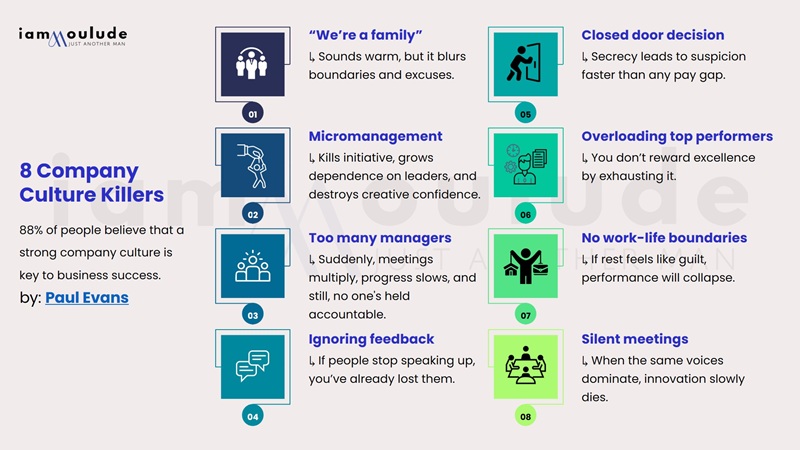
5. Decisions Behind Closed Doors
In organizational culture, secretive decision-making breeds speculation, fear and mistrust. When leadership decisions lack transparency, rumors fill the information gap, alignment breaks down and people disengage emotionally
“Trust is built with consistency.” — Howard Schultz, Former CEO of Starbucks
Opaque decision-making erodes trust, as employees speculate about motives and feel excluded from the company’s direction. This “closed doors” approach fosters division and undermining unity. Transparency builds bridges.
Sharing rationales for decisions – through town halls or memos helps align the team and adapt to evolving work norms. Leaders must understand that transparency does not mean consensus, it means context, clarity and communication.
6. Overloading Top Performers
High performers often become victims of their own excellence. Organizations reward them with more work; more pressure and less support. Meanwhile, underperformance is quietly tolerated elsewhere. This creates regular burnout, resentment and loss of star talent!
“You don’t reward high performance by punishing it.” — Patty McCord, former Chief Talent Officer at Netflix
Piling extra work on star employees indicates rewards excellence with exhaustion. This creates an uneven playing field, where high achievers carry the load while others coast. Distribute responsibilities equitably and invest in training.
Elon Musk, CEO of Tesla and SpaceX, warns, “When something is important enough, you do it even if the odds are not in your favor.”
But even top performers need support; balancing loads ensures sustained performance across the board.
7. No Work-Life Balance
A culture that glorifies exhaustion eventually pays the price in mental health issues, reduced productivity and high attrition. Working long hours is not commitment – it’s often a symptom of poor systems and unclear priorities.
“Burnout is not the price you pay for success; it’s the cost of poor leadership.” — Arianna Huffington
Modern cultures focus on energy management, not just time management. It promotes boundaries with policies like flexible hours or mandatory time off. Sheryl Sandberg, former COO of Meta, advocates, “We need to resist the tyranny of low expectations. We need to open our eyes to the inequality that remains.”
Extending this to work-life balance means expecting excellence without exploitation.
8. Silent Meetings
When meetings are quiet, it doesn’t mean alignment, it often means fear. People stay silent when they feel unsafe disagreeing, ideas are dismissed and leadership dominates conversation. Psychological safety is not a “soft skill”; it’s a performance multiplier.
“The ability to speak up without fear is the foundation of innovation.” — Amy Edmondson, Harvard Professor
Dominant personalities dominate, while introverts or junior staff withhold valuable insights, leading to poor decisions. Companies must encourage participation through structured agendas and inclusive facilitation. As Simon Sinek, author and leadership expert, puts it, “A culture is strong when people work with each other, for each other.”
Tools like round-robin sharing ensure every voice contributes to collective success.
Additional Culture Killers to Watch For
While Evans’ list is insightful, other threats lurk in today’s workplaces. Here are three more to consider:
- Lack of Diversity and Inclusion: Homogeneous teams limit perspectives, hindering innovation. Sundar Pichai, CEO of Google, states, “A diverse mix of voices leads to better discussions, decisions, and outcomes for everyone.” Actively recruiting diverse talent and fostering inclusive practices combats this.
- Poor Communication Channels: Siloed departments breed misunderstandings. Howard Schultz, former CEO of Starbucks, said, “The most powerful and enduring brands are built from the heart.” Implementing tools for seamless cross-team dialogue strengthens bonds.
- Resistance to Change: Stagnant cultures fail to adapt. As Steve Jobs, co-founder of Apple, noted, “Innovation distinguishes between a leader and a follower.” Embracing agility through continuous learning keeps cultures vibrant.
Building a Thriving Culture: The Path Forward
Eradicating these killers requires intentional leadership. Start with self-assessment – survey your team, identify pain points and commit to change. As Lou Gerstner, former CEO of IBM, reflected, “Culture isn’t just one aspect of the game, it is the game.” Leaders must
invest in training, celebrate wins and lead by example.
A strong culture isn’t built overnight, but its rewards – engaged employees, innovation and sustained success! In the words of Jeff Bezos, founder of Amazon, “A brand for a company is like a reputation for a person. You earn reputation by trying to do hard things well.”
Apply this to culture, and your organization will not only survive but thrive.
Concluding Remarks: Culture Is a Daily Practice
Company culture is not built through workshops or vision decks. It is either built or destroyed through daily decisions, leadership behavior, conflict handing process, rewarding success and treating people under pressure.
Culture isn’t accidental, it’s shaped by leadership choices. Leaders who actively combat the “8 killers” (and similar pitfalls) create environments where people thrive, innovate and stay. The organizations that win long-term are not the ones with the smartest strategies, but the ones with cultures that enable people to execute those strategies with trust, energy, and ownership.
“Great cultures don’t happen by accident. They are designed, protected, and lived—every day.”




 iammoulude
Discussion
No comments yet.