
In an era where artificial intelligence permeates every facet of digital life, personal branding has transformed from a nice-to-have into an essential survival strategy. Traditionally, personal branding refers to the deliberate process of shaping how others perceive you – your expertise, values, personality and unique value proposition (USP). This is much like a company cultivates its corporate identity. But with AI tools enabling anyone to generate polished content, optimize profiles and analyze audience data at scale, the game has changed. AI democratizes access to professional-grade branding resources, yet it simultaneously amplifies the need for authenticity to stand out in a sea of algorithmically perfected personas.
This article delves into the evolution, opportunities, challenges and strategies for building a resilient personal brand amid AI’s rise, drawing on insights from industry experts and recent trends.
The Evolution of Personal Branding: From Analog to AI-Augmented
Personal branding isn’t new; it’s been around since the days of thought leaders like Dale Carnegie, who emphasized self-presentation in How to Win Friends and Influence People. However, the digital age accelerated its importance, with platforms like Facebook, LinkedIn and X (formerly Twitter) turning individuals into media entities. Now, AI supercharges this process. Tools like ChatGPT can draft bios, generate content ideas and even simulate audience interactions, while algorithms on social media analyze engagement data to refine messaging.

This evaluation outlined a very relevant question today – How individuals can shape, protect and grow their presence in a world powered by artificial intelligence
In today’s digital world, building a personal brandis more important than ever. But one huge force reshaping how we define and grow our personal brands is Artificial Intelligence (AI). From recommendation systems to chatbots, generative tools to automated visuals, AI is influencing what people see, hear and believe about others online.
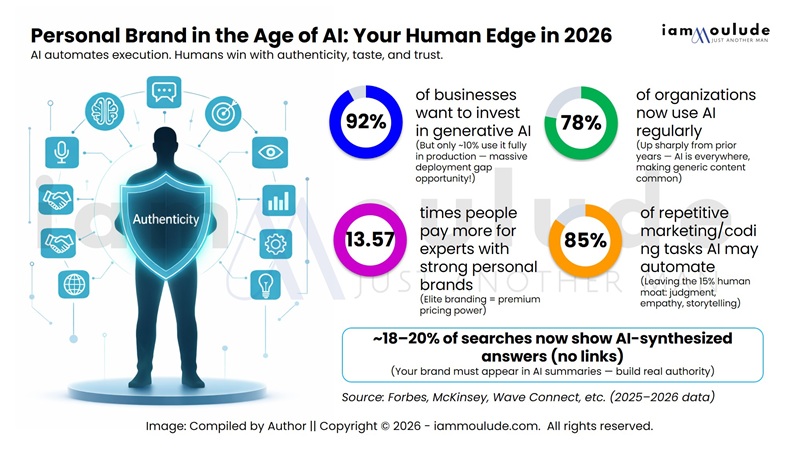
Consider the shift in scale where in 2023, AI adoption in U.S. businesses hovered around 3.7%, but by late 2025, it climbed to 9.7%, with generative AI reshaping content creation.
For personal brands, this means efficiency gains – AI can handle repetitive tasks like editing videos or optimizing SEO, but it also introduces a paradox. As Gary Vaynerchuk notes, “Your personal brand is your reputation,” and in an AI-saturated world, it’s becoming more valuable because it’s inherently human and uncopiable. Posts on different social and professional media echo this sentiment, with users emphasizing that while AI can automate execution, human judgments like taste, curation and direction remains irreplaceable.
Analytically, this evolution mirrors historical tech shifts. Just as electricity took decades to reshape manufacturing due to infrastructural hurdles, AI’s impact on branding faces adoption bottlenecks like organizational inertia and trust issues.
Deloitte’s reports highlight that only 34% of companies are reimagining operations around AI, creating a “deployment gap” where early adopters who blend AI with personal authenticity gain a competitive edge.
Opportunities: How AI Empowers Personal Branding
AI isn’t a threat; it’s an amplifier for those who wield it wisely. One key opportunity lies in personalization. AI algorithms can sift through audience data to tailor content, helping brands resonate more deeply. For instance, tools like HyperWrite or Claude can generate customized LinkedIn posts or email campaigns, freeing creators to focus on strategy.
This is particularly potent for job seekers. In recruitment, where AI screens resume for keywords, a strong personal brand – showcased through blogs, podcasts or social/professional media threads bypasses algorithms by appealing directly to human decision-makers.
Another boon is scalability. Influencers and entrepreneurs can use AI for content curation, such as summarizing trends or creating visuals, expanding reach without burnout. A 2025 Forbes piece argues that AI enhances empathy in branding by enabling hyper-personalized interactions, like chatbots that maintain a leader’s voice while handling inquiries.
On different platform, discussions reveal practical applications like AI for lead scoring and CRM updates, paired with human skills like negotiation, creates hybrid sales funnels that drive revenue.
Quantitatively, the numbers support this. With 5.1 billion social media users globally, AI helps niche down, tools like PubChemPy or RDKit (for specialized fields) can even assist in creating domain-specific content, but the real win is in building trust through consistent, value-driven output.
With the rise of such advanced technology, many users summarize that – AI saves time and humans close deals.
Challenges: The Risks of Over-Reliance on AI
Despite the upsides, AI poses risks to authenticity, the cornerstone of effective branding. Overuse can lead to homogenized content. Think generic LinkedIn posts that scream “AI-generated” with forced structures like “Not A, not B, but C.”
This dilutes uniqueness, as Bernard Kelvin Clive warns: “Let AI assist you, but let people feel your human touch.”
A deeper challenge is the erosion of trust. In a world of deepfakes and AI avatars, audiences crave realness. Research from IEEE highlights that personal branding must leverage irreplaceable human traits like empathy and storytelling, which AI can’t fully replicate.
Moreover, data-driven decisions can trap brands in echo chambers. A prime example is where analytics show high engagement with certain content, creators might pivot away from their core identity, limiting growth.
Analytically, this creates a bifurcated market. While 71% of organizations have introduced generative AI, only 6% deploy agentic AI fully, indicating hesitation due to ethical concerns like bias or misinformation.
Without balance, brands risk becoming commoditized, where attention shifts to those with genuine narratives.
Strategies for Success: Building an AI-Resilient Personal Brand
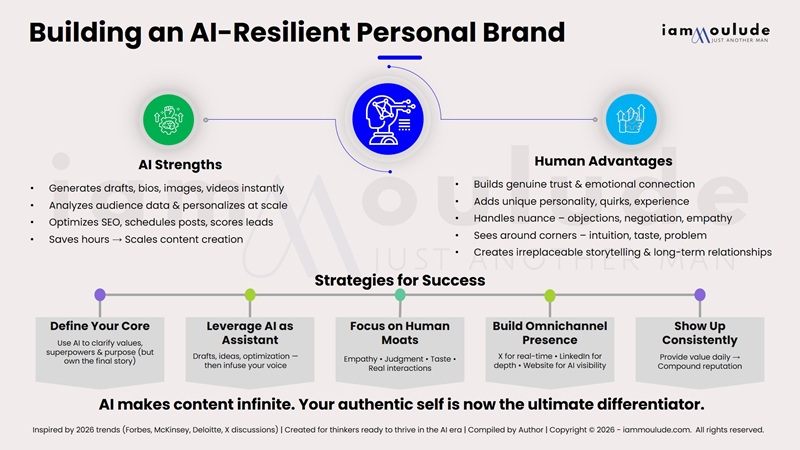
To thrive, integrate AI as a tool, not a crutch. If AI is here to stay (and it is), here’s how you can build a meaningful personal presence in this new era:
1. Define Your Core
Start with self-awareness by answering “Why” and “What”. Define your unique story “why” and values “what” before deploying AI. Use prompts like those shared on different platforms for branding exercises, but always personalize the outputs.
2. Focus on Human Moats
Share insights, stories, or reflections only you could share! Things AI cannot replicate because they come from lived experience. As one developer advises, become the “DB Query Expert” by contributing value consistently, using AI to amplify but not replace expertise. For example, leverage AI for ideation (e.g., “Generate 10 tweet ideas on personal branding”), then infuse them with your voice.
3. Build Omnichannel Presence
Learn how recommendation systems work (e.g., what types of posts get pushed, what engages audiences). You don’t need to master tech, but knowing the basics helps. Build omnichannel presence – Facebook for social sharing, LinkedIn for professional depth and X for real-time engagement. Prioritize human elements like live interactions or storytelling.
4. Leverage AI as Assistant
AI is a multiplier not a replacement for identity. AI can generate content at scale, refine language, analyze trends and optimize visibility. As AI evolves, so should your brand. Founders like Dain Walker emphasize that in a post-AI world, branding shifts to taste and problem-solving over raw execution.
5. Show Up Consistently
Repetition builds reputation. Randomness builds confusion. In the AI era, attention is fragmented. Algorithms reward familiarity. Audiences trust predictability. Consistency is not about being repetitive – it’s about being recognizable.
6. Measure success holistically
Track engagement, but also qualitative feedback. Tools like Postwise AI can schedule content, but refine based on principles – show up, earn attention, provide value.
Optimize the personal branding strategy with AI and human edge. The stratetis summary can be outlined as –
| Strategy | AI Role | Human Edge |
| Content Creation | Generate drafts, optimize SEO | Add personal anecdotes, empathy |
| Audience Analysis | Data insights, personalization | Interpret nuances, build relationships |
| Profile Optimization | Keyword suggestions, bio tweaks | Authentic voice, unique storytelling |
| Engagement | Automated responses, scheduling | Genuine interactions, trust-building |
Case Studies: Real-World Examples
Look at Gary Vaynerchuk, whose brand thrives on raw authenticity amid AI hype. He frames branding as “framing, not faking,” using AI sparingly to enhance his human-centric content.
Similarly, Lyn Tukei’s experiment with ChatGPT caricatures underscores intentional positioning: By prompting AI to visualize her brand, she ensures alignment between digital perception and reality.
In tech, founders like Matt Shumer highlight AI’s role in business but stress personal branding as a buffer against disruption.
Conclusion: The Future is Human-AI Hybrid
AI is a powerful force shaping how people discover, perceive and talk about you. But it doesn’t replace what makes you unique – your values, perspective and voice. Personal branding in the AI era means being authentic, consistent, tech-savvy, not tech-dependent and protective of your identity. AI tools can help you express yourself – but the core of every memorable brand remains human.
In the age of AI, personal branding isn’t about outrunning machines – it’s about out-humaning them. As capabilities explode, the deployment gap offers a window for individuals to blend AI’s efficiency with irreplaceable human qualities like creativity and trust.
Those who treat AI as an assistant, not a replacement, will forge brands that endure. Remember: In a world of infinite content, your authentic self is the ultimate differentiator. Start building today – your future self (and algorithms) will thank you.




 iammoulude
Discussion
No comments yet.