
I started e-commerce business back in 2013 with my own online marketplace, Ojonika. Back then, Bangladesh e-commerce was still in its early experimental stage – no structured playbooks, limited logistics, fragile trust, manual processes and pure hustle-driven execution. Facebook pages were doubling as storefronts. Cash on Delivery was a trust hack, not a system. And every single order felt like a small victory. Ojonika was born in that environment – raw, uncertain and full of belief.
We didn’t have automation. We had hustle.
We didn’t have data dashboards. We had instinct.
We didn’t have growth capital. We had conviction.
From 2013 onward, I experienced the early growth pains firsthand – supplier inconsistency, customer trust issues, courier unreliability, return headaches and the constant struggle to balance cash flow. Every campaign was a lesson. Every complaint was feedback. Every successful delivery was credibility earned. I continued the venture until 2018. By then, the market was shifting. Larger platforms were entering aggressively. Discount wars began shaping customer expectations. Paid acquisition costs were rising. Consumer behavior was evolving.

After 2018, I was no longer directly operating an e-commerce platform. But I never left the ecosystem. As a professional working in digital payment, e-commerce remained my favorite playground. In many ways, moving into digital payment gave me a deeper vantage point. I began to see what most founders don’t get to see clearly:
- Transaction patterns
- Checkout drop-offs
- Payment preference psychology
- Trust behavior around prepaid vs COD
- Cashback-driven buying spikes
From that perspective, I could observe e-commerce not just as a seller – but as an infrastructure participant. I’ve been in Bangladesh e-commerce long enough to see three cycles:
- The early optimism phase (cheap Facebook ads + COD growth)
- The hyper-discount madness phase
- The trust crisis and consolidation phase
I stayed connected with industry professionals – founders, payment partners, logistics players, marketers. Conversations shifted over the years. Earlier it was about “growth at any cost.” Now it’s about sustainability, margin discipline and operational control. What these 12+ years taught me is this – E-commerce in Bangladesh is not just about traffic, technology or discount. It is fundamentally about understanding consumer psychology within a trust-sensitive market.
And that’s exactly where impulse purchase becomes strategically powerful. It remains one of the most misunderstood, yet powerful behavioral levers in our market. Impulse purchase is not about discounts. It’s about psychology, timing and friction. Offline retailers in Bangladesh mastered impulse decades ago. From checkout candies in Shantinagar groceries to last-minute upsells in Bashundhara City – they understood human behavior.
Online? We’re still learning. In this blog, I will try to breaks down how to apply real-world impulse triggers to Bangladesh’s digital ecosystem – strategically, sustainably and profitably.
First, Let’s Be Clear: What Is Impulse Purchase?
First off, what exactly is an impulse purchase? It’s that spontaneous “I need this now” decision – think grabbing a chocolate bar at the supermarket checkout or snagging a trendy hijab from a street vendor because it caught your eye. In e-commerce, it’s the add-to-cart moment driven by emotion, not necessity.
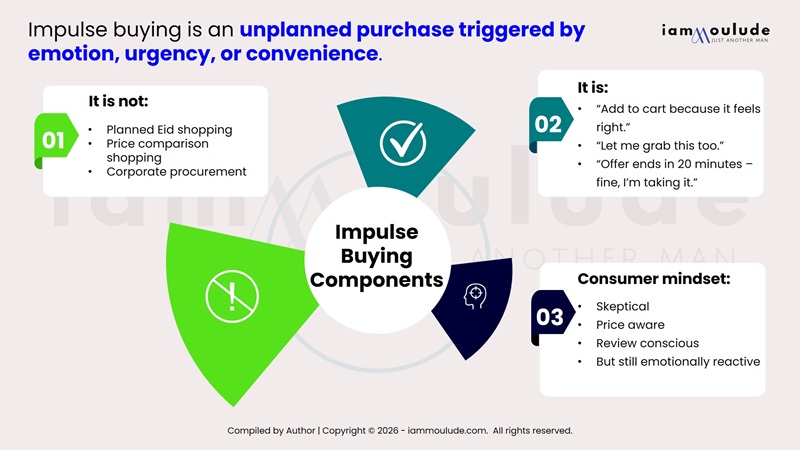
In Bangladesh, impulse buying is massive. Impulse purchase is extremely powerful here – because we are emotionally driven consumers, socially influenced, promotion sensitive, mobile-first decision makers and increasingly affluent in urban areas like Dhaka and Chittagong. According to recent reports, e-commerce here is projected to hit $5 billion by 2025, with mobile transactions leading the charge. But here’s the kicker from my experience – Bangladeshis love a good deal, influenced by our haggling culture in physical markets like New Market or Bashundhara City. Economic factors play in too – rising inflation means shoppers are value-hungry, but festivals like Eid or Pohela Boishakh trigger splurges.
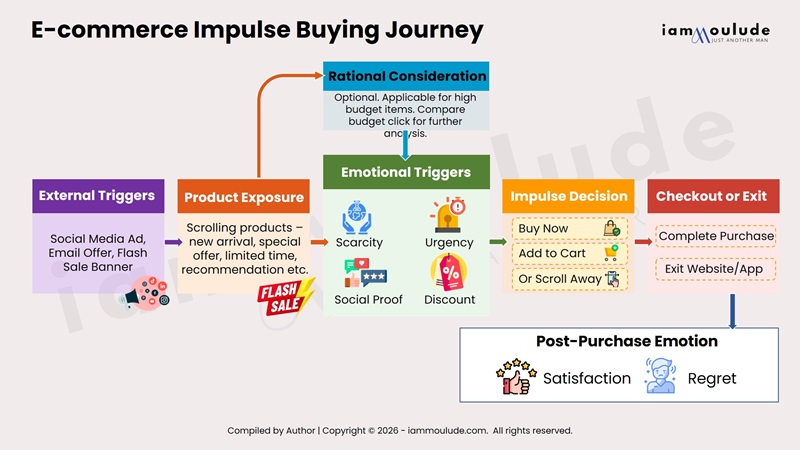
The challenge? Online, there’s no physical “touch and feel,” so impulse rates can dip. Yet, I’ve seen sites boost conversion by 20-30% by mimicking real-world tactics. The key is psychology: scarcity, urgency, and visual appeal. Platforms like Daraz Bangladesh, Evaly and Pickaboo shaped consumer expectations in different ways.
- Daraz trained users for flash sales.
- Evaly abused urgency psychology.
- Pickaboo leveraged gadget desire.
After the collapse of aggressive discount models, trust became fragile. It shifted expectation and shaped the new mindset of customers, that’s your window.
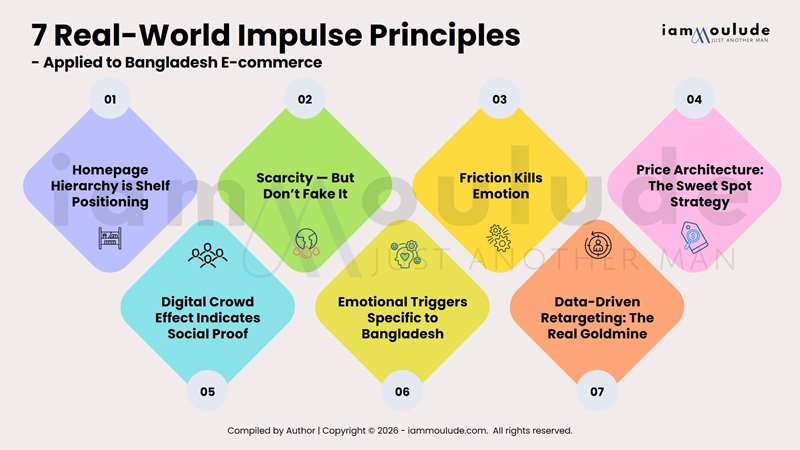
7 Real-World Impulse Principles – Applied to Bangladesh E-commerce
1. Homepage Hierarchy is Shelf Positioning
If you’ve ever walked into a supermarket in Dhaka, you’ll notice something subtle but powerful. Eye-level shelves carry high-margin brands, end-cap displays push promotional products and checkout counters carry small, impulse-friendly items. That’s not random. That’s shelf positioning psychology.
Now translate that into e-commerce. Your homepage hierarchy is your digital shelf positioning. On your website or app:
- Above-the-fold section = Eye-level shelf
- First 2–3 scrolls = Mid-tier placement
- Footer or deep category pages = Bottom shelf
Here’s the harsh truth – if your impulse products live inside category filters, they are already invisible. Impulse items must live in high-traffic, high-visibility zones.
Strategic move: Create a dynamic “Impulse Strip” on homepage – low ticket, high margin, fast decision products (BDT 199–999 range). Examples are mobile accessories, beauty minis, limited-time gadget add-ons and lifestyle micro-products etc. Don’t place impulse items in category depth. Place them in high-traffic zones.
2. Scarcity — But Don’t Fake It
Scarcity is one of the most powerful triggers in consumer psychology. But in Bangladesh e-commerce, it has also been one of the most abused. And once abused, it stops working. Real scarcity works. Fake scarcity destroys lifetime value. Scarcity triggers three things – Fear of Missing Out (FOMO), Perceived Value Increase and Faster Decision-Making.
But, the problem in Bangladesh is credibility.We’ve seen this before –
- “Only 3 left!” — for weeks
- Countdown timers that reset daily
- “Mega sale ending tonight” — every night
Such things help conversions go up for short term. But in long run, trust collapses. And in a trust-sensitive market like Bangladesh, once credibility is damaged, recovery is expensive. Consumers here are already skeptical due to past industry incidents. If they sense manipulation, they disengage – not just from the product, but from the brand. Impulse is built on urgency and credibility. If credibility dies, impulse dies.
3. Friction Kills Emotion
Impulse buying is emotional while friction is rational. If the checkout encountered issues like slow load, asks for too many fields or redirects too much, you lose the emotional window. In mobile-heavy environment of Bangladesh many users have unstable internet, use mid-range devices and prefer COD. Emotion lasts seconds so the system must match that speed. Hence optimize for –
- One-click repeat purchase
- Autofill addresses
- Express checkout
- Fast COD confirmation
4. Price Architecture: The Sweet Spot Strategy
In Bangladesh, impulse price zone usually sits between BDT 149 – 1,499.Why? Because below 149 feels cheap and above 1,500 triggers research behavior. Impulse product characteristics are –
- Low perceived risk
- High emotional appeal
- Easy justification
A very usual thought of consumer in impulse buying like “It’s just 399 taka – let me take it.” Similarly bundle strategy works extremely well like phone + impulse earbuds, skincare + mini trial, laptop + cleaning kit etc. Impulse should increase AOV without increasing acquisition cost.
5. Digital Crowd Indicates Social Proof
In Bashundhara City, crowd attracts crowd. But for online version, you need social proof. Digital crowd can use as a social proof. The online version crowd may include but not limited to –
- Real-time purchase notifications
- “20 people bought this today”
- Verified reviews with photos
- UGC reels
Bangladeshi buyers trust other buyers more than brands. But again – fake reviews destroy brand long-term. Build authentic community. Especially through micro-influencers, campus ambassadors and/or Facebook group engagement. Impulse is amplified by validation.
6. Emotional Triggers Specific to Bangladesh
Impulse triggers are culturally sensitive. While impulse buying is universal, emotional triggers are local. What pushes a customer in New York to buy is not always what pushes a customer in Dhaka, Chattogram or Sylhet. After observing this market for over a decade, I can confidently say – Bangladesh has its own emotional wiring. If you don’t align with it, your impulse strategy will feel imported, not effective.
Here are some that work locally:
a) Festival Urgency
Instead of:
- “Flat 20% off”
Use:
- “Eid Special Drop”
- “Boishakh Limited Collection”
- “Wedding Season Essentials”
- 11.11 / 12.12 sales (trained by Daraz)
b) Status & Aspiration
Bangladesh has a strong upward mobility mindset, especially among youth and urban professionals. Impulse purchases often come from desire to upgrade lifestyle, social media visibility, peer comparison and/or “I deserve this” psychology. Gadgets, fashion, beauty and lifestyle accessories perform strongly here. But presentation matters.
Premium visuals with clean branding and modern tone generates higher impulse response. It’s not always about price. It’s about perceived progress. Young urban buyers want:
- Premium lifestyle feels
- Tech upgrades
- Instagram-worthy products
c) Convenience
Urban Bangladesh is busy and chaotic. Having traffic, work pressure, family responsibility in daily life, convenience becomes an emotional trigger. Impulse happens when:
- Delivery promise is fast
- Return policy is clear
- Process feels effortless
If buying feels easy, people reward that ease. In many cases, customers aren’t just buying a product. They’re buying relief.
d) Smart Savings Satisfaction
Unlike some markets, Bangladeshi consumers enjoy the feeling of “smart buying.” Impulse can be triggered by:
- Cashback
- Voucher stacking
- Flash deal
- Reward coins
The emotional trigger here is not just desire – it’s victory. However, overuse of artificial discounts destroys this effect. The deal must feel rare or exclusive.
e) Social Proof & Crowd Behavior
Bangladesh is a socially influenced market. People feel safer when:
- Others have bought
- Reviews are visible
- Influencers endorse
- Friends recommend
Crowd behavior amplifies impulse. “Trending Now” sections work extremely well here — if authentic.
7. Data-Driven Retargeting: The Real Goldmine
Most impulse doesn’t happen on first visit. It happens when user saw product, forgot about it and/or got retargeted with right timing. Here the real goldmine of impulse buying lies – the data drive retargeting. Use:
- Dynamic Facebook retargeting
- SMS reminder with urgency
- Push notification for price drop
But in retargeting the timing matters – within 6 hours equals highest emotional recall, within 24 hours means still warm and after 3 days its mostly dead. Remember impulse window is short, you need to react fast.
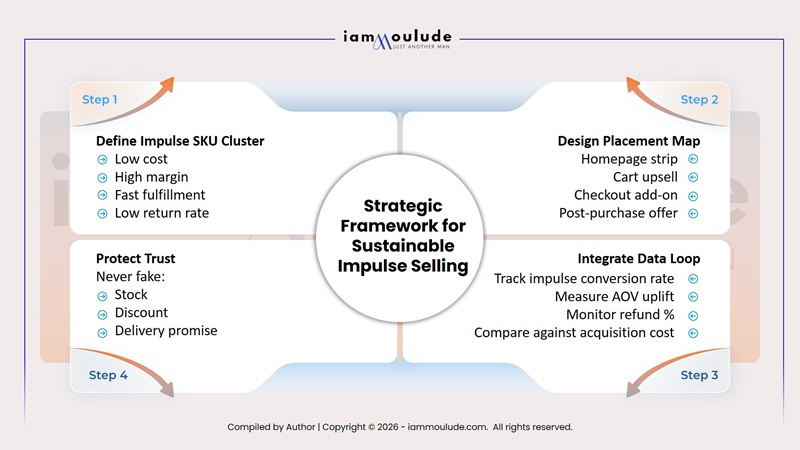
Strategic Framework for Sustainable Impulse Selling
If I were advising a Bangladesh e-commerce founder today, I wouldn’t start with “Let’s run a flash sale.” I would build impulse as a structured revenue layer – not a campaign tactic. Here’s how I would approach it.
Step 1: Define the Right Impulse SKU Cluster
Impulse is not for every product. Trying to force impulse on high-consideration items (expensive electronics, furniture, premium appliances) is a waste of energy. Those require research and comparison. You need a dedicated impulse SKU cluster. What Makes a Good Impulse SKU in Bangladesh? Let’s explore –
1. Low Cost (Psychological Comfort Zone): Usually within a range that feels “safe.” The customer should not need family approval or long thinking.
2. High Margin: Impulse products should improve AOV and margin – not dilute it. If your impulse item has 8–10% margin, it’s not strategic. Aim for healthy cushion.
3. Fast Fulfillment: If delivery takes 5–7 days, the emotional connection weakens. Impulse thrives when gratification is quick.
4. Low Return Rate: Avoid size-sensitive, highly expectation-driven products. Accessories, add-ons, consumables, mini packs, practical gadgets perform better.
Step 2: Design a Placement Map (Revenue Architecture)
Impulse products should not depend on discovery. They should intercept buying intent. Think of it as designing traffic intersections.
1. Homepage Strip: This is your digital “end-cap display.” Use it for:
- Trending small-ticket items
- Limited stock signals
- Festival micro-products
Keep it visible without scrolling too much.
2. Cart Upsell: This is highly effective. Example, Customer adds a phone show screen protector, budget earbuds and/or cleaning kit. The psychology is simple – “Since I’m already buying, let me add this.” No extra marketing cost. Pure AOV lift.
3. Checkout Add-On: This is your checkout counter candy. Small, frictionless items like under BDT 499, no customization and/or one-click add. However, do not overcrowd this area. One strong suggestion works better than five weak ones.
4. Post-Purchase Offer: Most founders ignore this. After order confirmation:
- Offer a limited-time add-on
- Valid for 10–20 minutes
- No extra delivery charge
Customer already trusts you at this stage. Conversion probability is high.
Step 3: Integrate a Data Loop
Impulse without measurement becomes emotional gambling. You must treat it scientifically. Track these 4 metrics –
1. Impulse Conversion Rate
How many users accept upsell suggestions? If below expectation, check:
- Placement
- Price
- Relevance
2. AOV Uplift
Compare:
- AOV before impulse layer
- AOV after impulse layer
Impulse should create measurable lift – ideally 10–25% depending on category.
3. Refund & Return Rate
Impulse items should not increase return headaches. If return spikes:
- Product quality issue
- Wrong audience targeting
- Misleading product description
Impulse must remain operationally safe.
4. Compare Against Acquisition Cost (CAC)
Impulse works best when it increases revenue without increasing ad spend. If your CAC is BDT 200 per order and impulse adds BDT 300 in margin, that’s strategic leverage. Impulse is one of the cleanest ways to improve unit economics.
Step 4: Protect Trust at All Costs
This is where many platforms failed. Impulse can scale revenue. But trust sustains business. Never fake:
- Stock levels
- Discount percentages
- Delivery timelines
In Bangladesh, trust damage spreads fast – especially through social media. Remember that trust compounds and impulse multiply on top of trust. Without trust, urgency feels manipulation and with trust, urgency feels opportunity.
Challenges in Bangladesh E-Commerce and How to Overcome Them
No rose without thorns. Our market has hurdles:
- Trust Issues: Post-scam era, users hesitate. Solution: Transparent policies, COD options, and partnerships with trusted brands like Unilever.
- Logistics Bottlenecks: Delays kill post-impulse regret. Invest in hyperlocal fulfillment—I’ve seen 20% retention lifts from reliable delivery.
- Payment Friction: Not everyone has cards. Embrace bKash, Nagad, and even installment plans for mid-range impulses.
- Competition from Giants: Daraz dominates, but niches win. Focus on underserved areas like organic groceries or regional crafts.
Strategic Thought: Track metrics like cart abandonment (aim under 60%) and impulse share (target 20-30% of sales). Use Google Analytics or local tools like Shohoz for insights.
After 12 years in this industry, I can confidently say that impulse buying is not manipulation. It is facilitating fast decisions when value is clear. If your product solves something small but real, price feels fair, experience is smooth and delivery is reliable then impulse becomes a growth engine. But with overpromise, over-discount and under-deliver, impulse becomes your downfall.
Bangladesh e-commerce is entering a more mature phase. The winners won’t be the loudest, rather the most disciplined. And disciplined impulse strategy – executed with integrity, is one of the highest ROI levers left in this market. By blending real-world bazaar wisdom with digital tools, you can turn browsers into buyers in Bangladesh’s vibrant e-commerce landscape. Start small, audit your site for urgency cues, test one tactic and scale.
If you’re an e-commerce owner reading this, drop a comment or hit me up!




 iammoulude
Discussion
No comments yet.